How to Negotiate a Law School Scholarship: Scripts and Timing (2026)
Law school scholarship negotiation works when you hold a competing offer. Timing, what to say, and where schools have the most flexibility to move.
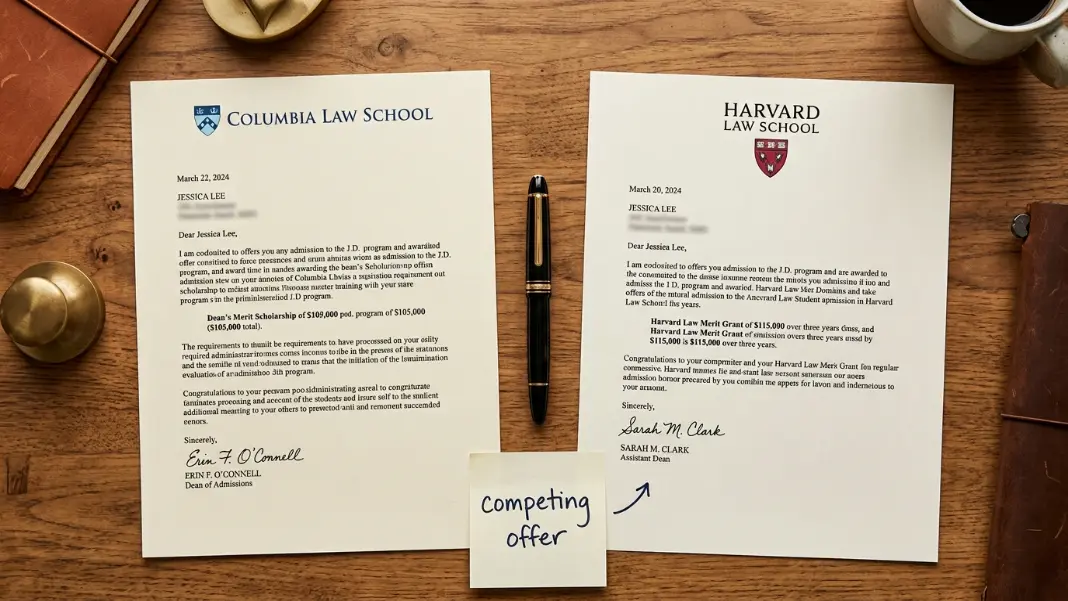
Most applicants who receive a scholarship offer below what they need treat it as a final answer. Law schools count on that assumption. Scholarship negotiation is a standard part of the admissions process. Admissions offices expect it, budget for it, and in many cases have already anticipated that some applicants will push back before accepting.
The reason it works is the same reason merit scholarships exist at all. Schools offer aid to attract applicants who improve their LSAT medians. When a high-scoring applicant holds a competing offer from a comparable school, the original school faces a real choice: improve the offer or lose a candidate who helps their statistics. That dynamic is what creates room to negotiate. The Law School Scholarship Calculator estimates where your numbers give you the most leverage before you apply.
This post covers when to negotiate, what to say, how to frame the ask, and where schools have the most room to move.
Why Most Applicants Leave Scholarship Money on the Table#
The most common reason scholarship negotiation does not happen is that applicants assume the offer is fixed. Scholarship letters rarely say "this amount is negotiable." The format looks like a formal decision, not an opening position. Most applicants treat it as one.
The second reason is discomfort. Applicants who have been working toward admission for months do not want to do anything that might jeopardize a seat they have already earned. The fear that negotiating could lead to a rescinded offer keeps many from asking at all.
Both concerns are real but overblown. Law schools have financial aid processes that include a negotiation stage. Admissions staff who handle scholarship inquiries deal with these conversations regularly and do not treat them as adversarial. The risk of a rescinded offer for making a professional, polite inquiry about scholarship funding is negligible at any accredited school.
The more accurate concern is not asking too boldly, but asking at the wrong time or without the right leverage. A request for more money without a competing offer from a comparable school rarely produces movement. Schools have a basis for declining: the original offer reflected your numbers, and without a specific reason to reconsider, there is no mechanism that forces a change.
The practical result is a large number of admitted students who held real leverage in the form of competing offers and never used it.
The Competing Offer: The Only Leverage That Consistently Moves Schools#
The most effective tool in law school scholarship negotiation is a written offer from a school of similar or higher rank that includes a higher scholarship amount.
Schools are not competing against an abstract idea of what you deserve. They are competing against a specific alternative you can walk toward. A competing offer from a school at the same prestige tier makes the choice concrete: improve or lose this candidate.
The key qualifier is that the competing school needs to be at a similar or higher rank. A competing offer from a school ranked 40 positions below your target will have limited impact on a school that knows you would only choose the lower-ranked offer if you voluntarily preferred it. A competing offer from a school in the same tier, or higher, creates real pressure. The how law school scholarships work guide covers why the competing offer is the mechanism that triggers revision, because merit aid flows to applicants who improve statistics and losing them to a comparable school is a direct cost.
The competing offer approach works best between schools that share a recruiting market. A 170 LSAT applicant comparing Georgetown's offer against George Washington's gives Georgetown something specific to respond to, because they compete for similar candidates. The same applicant using an offer from a much lower-ranked school as leverage with Georgetown is unlikely to move the needle, because those schools are not directly competing for the same applicant pool.
One firm rule: the competing offer must be real. Do not fabricate an offer or misrepresent its terms. Schools sometimes ask for documentation, and any misrepresentation will damage your relationship with the admissions office in ways that outweigh any potential financial gain.
How to Write the Scholarship Negotiation Email#
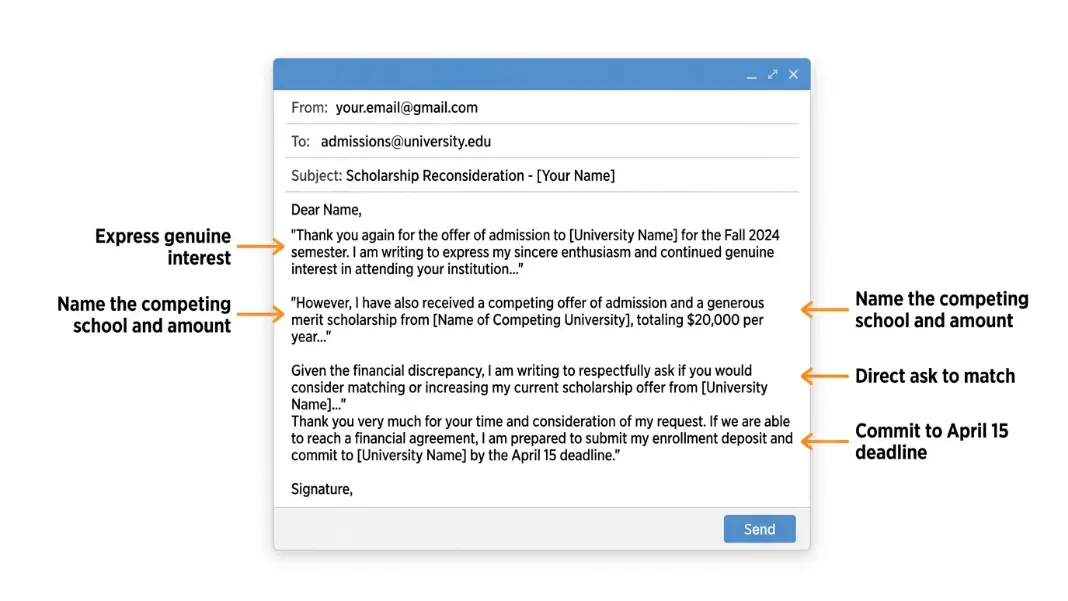
The scholarship negotiation request should be brief, specific, and professional. Long emails with multiple paragraphs of explanation work against you. Admissions officers read dozens of these each spring.
The structure that works:
- Open with brief, genuine interest in the school
- Name the competing school and the offer amount specifically
- Make a direct ask: match the offer, or move toward it
- Close with a commitment deadline
Here is a working template:
Subject: Scholarship Reconsideration Request – [Your Name]

Dear [Admissions Contact Name],

Thank you for the admission offer and the scholarship of [X] per year.
[School Name] is genuinely one of my top choices, and I am excited
about the program.

I have also received an offer from [Competing School] that includes
a scholarship of [Y] per year. Since both programs are strong fits
for my goals in [practice area], I wanted to ask whether you would
be able to review my scholarship and bring it closer to that amount.

I would welcome any opportunity to discuss this further. I plan to
make my decision by April 15 and would be glad to confirm my
enrollment at [School Name] if we are able to find an agreement.

Thank you for your time and consideration.

[Your Name]
[LSAT Score] | [GPA]
Keep the competing school named. Vague references to "another offer" are less effective than naming the school, because it forces the admissions office to assess who they are actually competing against.
If you receive no response within 7 to 10 business days, one follow-up email is appropriate. After that, accept that the school is not in a position to move and make your decision accordingly.
When to Negotiate (and When You Have Already Waited Too Long)#
Timing matters more than most applicants realize.
The most effective negotiation window is between April 1 and April 14. By early April, schools have a clearer picture of their incoming class. They know who has deposited, who is still deciding, and which scholarship allocations remain open. An applicant who is genuinely undecided between two comparable schools in April represents a real opportunity for whichever school is willing to move.
Earlier in the cycle is a different situation. Schools that admit in December or January are still managing a large uncertain applicant pool. They do not yet know how many of their target candidates will accept or what the competing offer landscape looks like across the board. Some schools will negotiate early in the cycle for standout applicants, but the motivation is less urgent and the flexibility is smaller.
After April 15, most negotiation leverage disappears. Deposit deadlines lock in the class, and schools that have filled their seats have no financial reason to improve offers for candidates who did not deposit. Scholarship adjustments do occasionally happen post-deposit for specific circumstances, but these are rare enough not to plan around.
The critical rule: do not start negotiating before you have a competing offer in hand. An email requesting more money without a specific alternative sounds like a request for a favor. An email presenting a competing offer from a named school positions you as someone making a real comparison, which is exactly the scenario schools are designed to respond to.

Schools Outside the T14: Where Negotiation Has the Most Room#
T14 schools negotiate less frequently and with less flexibility than schools at lower tiers. The brand and employment outcomes of T14 programs attract enough applicants willing to accept the original offer that the cost of not negotiating is low for them compared to any other tier.
Outside the T14, the negotiation landscape is different. Schools ranked 15 to 50 compete directly against T14 programs for their best applicants. When a high-LSAT applicant holds an offer from a T14 and one from a school ranked 25, the ranked-25 school has every reason to compete. These schools have processes for evaluating competing offers and often have explicit budget line items for scholarship adjustments.
Schools ranked 50 to 100 compete against the 15-50 tier. Full-tuition offers are the entry point for negotiation at this tier for applicants significantly above median. If you hold a partial offer from a school in this range and a competing full-tuition offer from a school 10 ranks higher, the original school has direct incentive to close the gap.
The schools least likely to negotiate are those where your numbers are at or below median. A school that made you a scholarship offer despite your numbers being below their median is typically working from a different budget allocation than a school competing to attract a statistical benefit. The more your LSAT was above median at the original school, the more leverage you have to negotiate.
For data on which schools give the most scholarship room by rank tier and where full-tuition offers are most common, see the full ride law school scholarships guide.
The LSAT Score Calculator shows your percentile position relative to school medians, which identifies where your negotiating leverage is before you have offers in hand.
Yes. Scholarship negotiation is standard in law school admissions. The most effective approach presents a competing offer from a school of similar or higher rank with a higher scholarship amount. Schools outside the T14 have the most flexibility to move, and the best window is between April 1 and April 15. Admissions offices handle these conversations regularly and do not treat them as adversarial. A professional, polite email with a specific competing offer is all you need to start the process.
A competing written offer from a school of similar or higher rank is the most effective tool. The offer needs to be real and specific. Vague references to "other interest" rarely move schools the way a named competing offer does. You also need to negotiate before the April 15 deposit deadline at most schools. Without a competing offer, scholarship negotiation rarely produces meaningful movement because schools have no specific reason to revise their position.
Send a short, professional email to your admissions contact. State your genuine continued interest in the school, name the competing school and their offer amount specifically, and make a direct ask for the school to match or move toward that number. Keep the email under 200 words. Do not write multiple paragraphs explaining financial hardship unless the school specifically asks. Follow up once if you receive no response within 7 to 10 business days.
No accredited law school will rescind admission because a student made a professional, polite scholarship inquiry. The concern is common but unfounded. Admissions offices handle these requests every admissions cycle and do not treat a scholarship question as a challenge to the admission decision. The only genuine risk comes from misrepresenting competing offers or making threatening statements, neither of which is part of a professional negotiation. A simple, direct inquiry carries no meaningful admission risk.
Yes. You can hold multiple admission offers simultaneously and pursue scholarship negotiations at more than one school. Use each school's offer as leverage with others where the schools are competing for similar applicants. Never misrepresent offer amounts or fabricate an offer at any school. Manage the timeline carefully so you meet each school's decision deadline and communicate clearly if you need a short extension. April 15 is the standard deadline, and most schools will grant a brief extension if asked before that date.
Accept that the offer reflects what that school is currently able to provide and make your decision on the full picture. Schools sometimes genuinely cannot move because their scholarship budget is fully allocated. A refusal is not necessarily a signal of limited interest in you as an applicant. If the gap between their offer and a competing school's offer is large enough to affect your decision, the competing school's offer may simply be the right financial choice. A school's willingness or ability to negotiate is itself information worth weighing.
Written by
Hassaan Rasheed
Web Developer & Content Researcher
Hassaan builds calculators and writes source-linked guides across the site's subject areas. Calculator methods and reference data are documented in each guide so readers can verify the underlying sources.
About the author and methods