Law School Scholarships for Women and Minorities: Where to Look (2026)
Law school scholarships for women and minorities come from two sources: school merit aid and external programs. How to find both and what qualifies.

The search for law school scholarships for women and minorities produces two completely different types of funding, and most guides treat them the same. School-based merit aid and external identity-based scholarships have different application processes, different selection criteria, and different timelines. Treating them as a single category leads applicants to miss deadlines, skip sources that would have qualified them, or assume they are ineligible for funding they could actually receive.
Understanding both categories, how they interact, and how to apply to each is the clearer path to a complete funding picture for law school. The Law School Scholarship Calculator covers school-based merit aid based on LSAT and GPA, which is the first layer. This post covers the second.
Two Types of Funding: Why the Distinction Changes Your Entire Search#
School-based merit aid is what most people think of first. It is awarded by law schools as part of the admission process and is based primarily on LSAT score and GPA relative to the school's medians. Diversity, gender, and background sometimes function as "plus factors" in holistic review at schools that weigh the full application. These factors can affect admission probability and, occasionally, scholarship amount. But at most non-T14 schools, the primary driver of merit aid is still your index numbers.
External identity-based scholarships come from bar foundations, national legal organizations, law firm diversity programs, affinity groups, and private foundations. These programs have their own application processes, separate deadlines, and sometimes require essays, recommendations, or interviews. They are not administered by the law school and operate on independent timelines. Some are open to applicants before they are admitted to law school. Others require enrollment.
The practical difference is this: you are eligible for merit aid from the school during the admission cycle, and you are eligible for external scholarships on a separate calendar that sometimes starts earlier. Missing external scholarship deadlines because you assumed all law school funding runs through the admission process is one of the most common and avoidable funding gaps for underrepresented applicants.
How Law Schools Factor Gender and Diversity Into Merit Aid#
Most law school admissions processes are holistic, which means the full application is reviewed beyond just LSAT and GPA. Being a woman, a first-generation college graduate, a member of an underrepresented racial or ethnic group, or a non-traditional student can function as a plus factor in that review.
What this means in practice is more nuanced than most applicants expect. At schools outside the T14, the LSAT-GPA index remains the dominant factor in both admission and scholarship allocation. Holistic factors more often affect the admission decision than the scholarship amount. A below-median LSAT applicant who is admitted as a diversity admit is typically receiving an admission offer that a median-plus applicant would have received based on numbers alone. The scholarship that comes with that offer may be smaller or absent.
At T14 schools, where the LSAT range is compressed and secondary factors carry more weight, background and diversity can more directly influence scholarship allocation. Several T14 programs have named endowment scholarships specifically for students from underrepresented backgrounds. Harvard's Program on Negotiation, Columbia's Harlan Fiske Stone Scholars, and similar programs often include funding components.
Some schools have created dedicated scholarship pools funded by donors for specific communities. These exist at both T14 and non-T14 programs and typically require a separate application within the admission process. The how law school scholarships work guide covers the broader merit aid mechanics that apply regardless of background.
Scholarships for Women in Law: Bar Foundations, Affinity Groups, and Named Programs#
The most reliable external scholarships for women in law come from three sources: state bar foundations, national legal organizations, and law firm diversity scholarship programs.
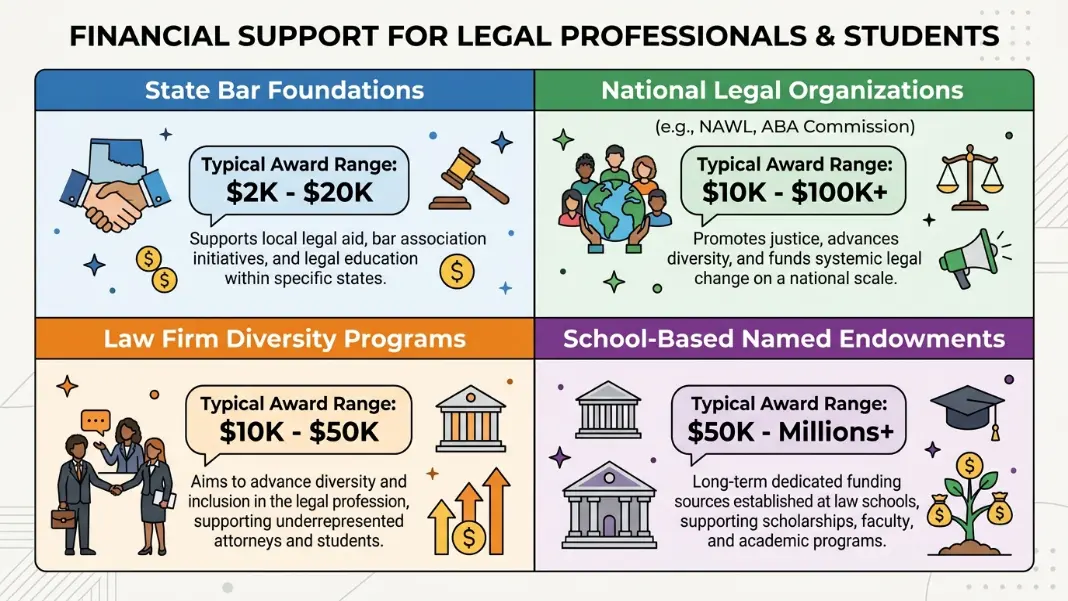
State bar foundations are among the most overlooked sources. Nearly every state bar association has a foundation that funds law school scholarships, and many have programs specifically for women or for applicants from underrepresented backgrounds. These scholarships range from $2,000 to $20,000 and typically require state residency or intent to practice in the state. Deadlines vary by state but cluster between January and March. Search the bar foundation in your target state and in any state where you intend to practice.
National legal organizations with scholarship programs for women include:
- ABA Commission on Women in the Profession: funds scholarships at multiple levels, including a student essay competition with cash awards
- National Association of Women Lawyers (NAWL) Foundation: offers fellowships and scholarships for women pursuing legal careers, with separate programs for 1L and upper-level students
- Women's Bar Association programs at the state level: many state WBA chapters run direct scholarship programs with awards ranging from $1,000 to $10,000
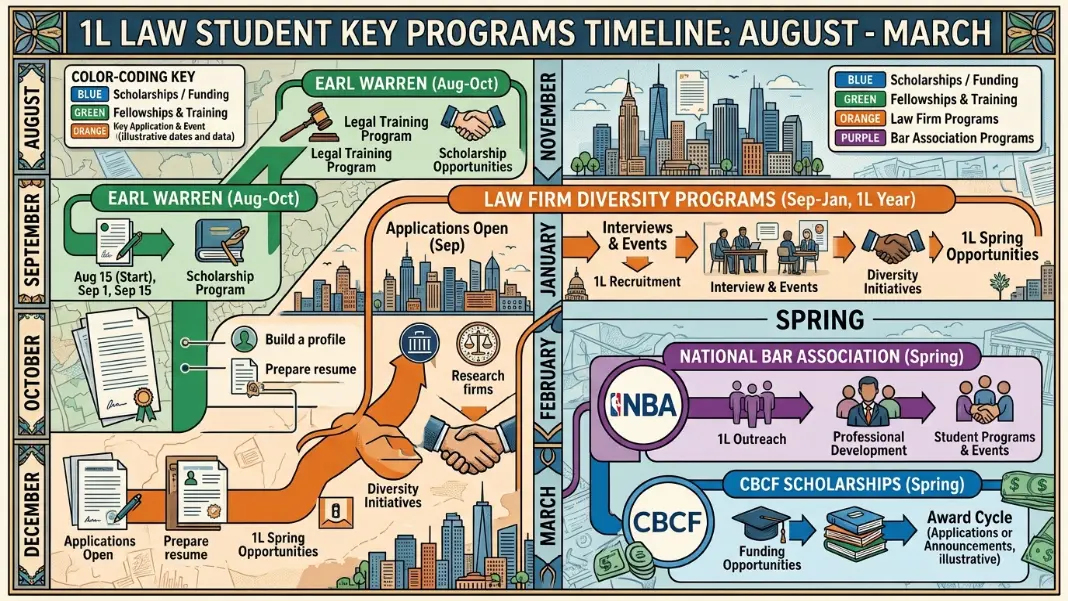
Law firm diversity scholarship programs are substantial and frequently overlooked. Large law firms including Kirkland and Ellis, Latham and Watkins, Orrick, and dozens of others run diversity scholarship programs that provide $10,000 to $50,000 per year for law students who meet eligibility criteria that typically include 1L enrollment and academic standing. These programs often include a summer associate offer alongside the scholarship. Applications typically open in the fall of 1L year and run through January.
Scholarships for Black Students and Underrepresented Minorities#
External scholarship programs for Black students and students from other underrepresented minority groups include some of the largest individual awards available to law school applicants.
Earl Warren Scholarship (NAACP Legal Defense Fund): One of the most competitive and prestigious law school scholarships for students of color. Awards $30,000 per year for up to three years. Eligibility requires enrollment at an ABA-accredited law school, a demonstrated commitment to civil rights and racial justice, and selection through a competitive review process. Applications typically open in August and are due in October for students starting law school the following fall.
Congressional Black Caucus Foundation Scholarships: Multiple scholarship programs for undergraduate and graduate students. The William L. Dawson Scholarship and the CBCF General Scholarship both accept applications from law students. Awards range from $2,500 to $10,000. Applications are due in the spring semester.
Thurgood Marshall College Fund: Programs available to students attending historically Black colleges and universities (HBCUs) and HBCU-affiliated law schools. Howard University School of Law, Southern University Law Center, and North Carolina Central School of Law are among the programs with TMCF connections.
American Bar Foundation Fellowships for Minority Law Students: The ABF offers research fellowships for undergraduate and graduate students from minority groups interested in legal research and policy. These are small in dollar amount but carry significant credential value and provide research experience.
National Bar Association Foundation: Scholarship programs specifically for Black law students, including the CLF Scholarships and individual state chapter programs. Awards range from $1,000 to $5,000 per year.
HBCU Law Schools and the Pipeline Programs Connected to Them#
Several historically Black colleges and universities operate ABA-accredited law schools that have both internal scholarship programs and external pipeline partnerships that are not available to students at other institutions.
Howard University School of Law (Washington, DC) is the most nationally prominent HBCU law school and has historically placed graduates in federal clerkships, public interest organizations, and government positions at rates competitive with higher-ranked schools. Howard's internal scholarship programs include merit awards and need-based support. External partnerships include Thurgood Marshall fellowships and specific bar association pipelines.
Southern University Law Center (Baton Rouge, LA) and North Carolina Central University School of Law (Durham, NC) offer significant merit aid to their incoming classes and maintain dedicated pipeline programs with state bar associations, minority bar chapters, and regional legal employers.
For students with a clear geographic preference or commitment to serving specific communities, HBCU law schools sometimes offer a combination of scholarship generosity, community, and career network that higher-ranked programs do not match for those specific outcomes.
Applying to Both Categories at the Same Time#
The timeline management for external and school-based scholarships is the part most applicants underestimate.
School merit aid is awarded during the admission cycle. If you are applying to law schools in the fall and spring of this year, the merit aid decisions come with admission letters in January through April. You do not need to take any separate action to be considered for automatic merit awards. Named school endowments sometimes require a separate internal application, which law schools announce after admission.
External scholarships run on independent timelines. The Earl Warren Scholarship opens in August for applicants enrolling the following fall, which means you may be applying before you have even taken the LSAT. Law firm diversity scholarship programs typically open in September or October of 1L year, after you have enrolled.
The most important early action is building your scholarship calendar. Research every external program you may be eligible for, note their deadlines, and confirm eligibility requirements. Many programs require a separate application through LSAC, which means you need an active account. The LSAC GPA Calculator helps you confirm your accurate LSAC GPA, which most external applications also require.
School-based merit aid and external scholarships are not in conflict. Receiving an external scholarship does not typically reduce school merit aid, though some schools have coordination-of-aid policies worth confirming. You can pursue both categories simultaneously.
For a complete picture of which schools give the most merit aid by rank tier, including full-tuition and full-ride programs and renewal policies, the law schools with best scholarships guide covers the school-side funding in detail.
Yes. Scholarships specifically for women in law come from state bar foundations, national legal organizations like the NAWL Foundation and ABA Commission on Women in the Profession, and law firm diversity scholarship programs. Most state bar foundations run scholarship programs for women, with deadlines clustering between January and March. Large law firms also offer diversity scholarships ranging from $10,000 to $50,000 for 1L students that often include a summer associate offer.
Major scholarship programs for Black law students include the Earl Warren Scholarship through the NAACP Legal Defense Fund ($30,000 per year for 3 years), Congressional Black Caucus Foundation scholarships, National Bar Association Foundation programs, and American Bar Foundation fellowships. HBCU law schools including Howard, Southern University, and North Carolina Central also have dedicated scholarship programs and pipeline partnerships not available at other institutions. Most applications open between August and October for students enrolling the following fall.
Most law school merit scholarships are awarded primarily based on LSAT and GPA relative to school medians, not background. Some schools have endowed named scholarships specifically for students from underrepresented backgrounds, which are awarded separately from automatic merit aid. At T14 schools, where LSAT scores are compressed, background and diversity factors carry more weight in both admission and scholarship allocation. The most significant identity-based funding for minority applicants typically comes from external programs rather than automatic school merit awards.
The Earl Warren Scholarship is awarded by the NAACP Legal Defense Fund to law students committed to civil rights and racial justice. It provides $30,000 per year for up to three years of law school. Selection is competitive and based on academic record, demonstrated commitment to racial justice, community involvement, and leadership. Applications typically open in August for students enrolling in law school the following fall. It is one of the highest-value law school scholarships available to students of color.
Start by building a scholarship calendar. Research programs you qualify for and note their deadlines, which range from August through March depending on the program. Most external scholarships require a separate application, essays, and often letters of recommendation. Many programs require an active LSAC account because they use LSAC's application system. Research state bar foundation programs in every state where you have a connection, as these are frequently overlooked. Apply to school-based merit aid through the regular admission process and external programs on their independent calendars.
Yes. School-based merit aid and external scholarships can generally be received simultaneously. Some schools have coordination-of-aid policies that apply when external awards exceed a certain amount, which may reduce need-based aid rather than merit scholarships. Confirm the specific policy with any school's financial aid office if you are receiving a large external award. Most external scholarship programs do not conflict with law school merit aid, and pursuing both categories is the standard approach for maximizing total funding.
Written by
Hassaan Rasheed
Web Developer & Content Researcher
Hassaan builds calculators and writes source-linked guides across the site's subject areas. Calculator methods and reference data are documented in each guide so readers can verify the underlying sources.
About the author and methods