How Law School Scholarships Work: LSAT, GPA, and Merit Aid Explained (2026)
Law school scholarships come down to LSAT and GPA vs school medians. How thresholds work, the renewal trap, and where full scholarships actually come from.
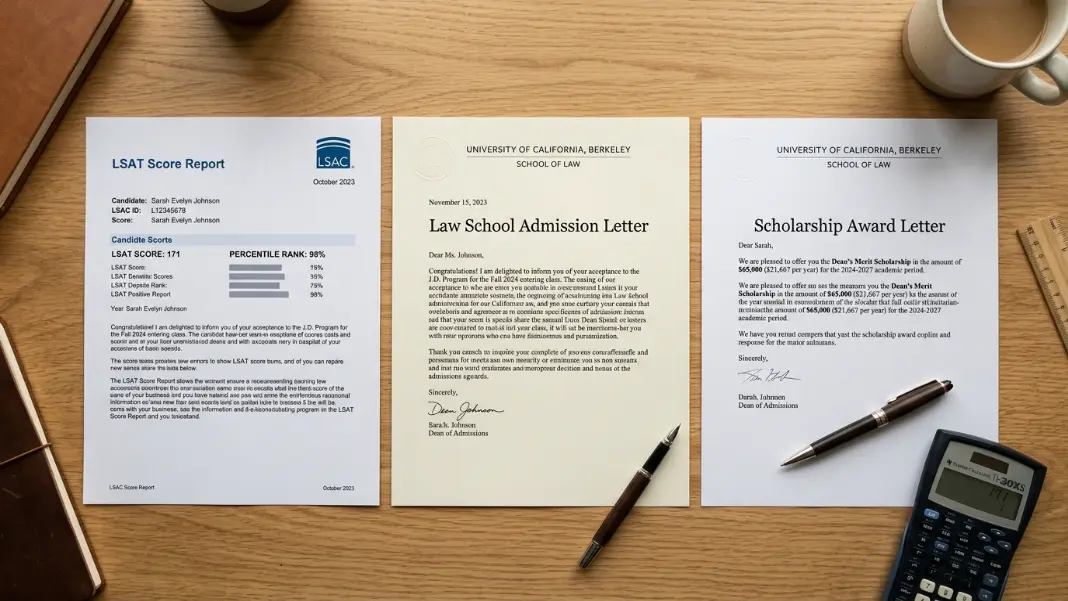
Most people assume law school scholarships work like undergraduate awards: fill out an application, write an essay, demonstrate need or achievement, and wait. Merit-based law school scholarships almost never work that way. The process is more transactional, more predictable, and far more useful to the applicant who understands what is actually driving it.
Law school scholarships are awarded based primarily on your LSAT score and GPA relative to a given school's current student medians. Schools use merit aid to attract applicants who improve their statistics, not primarily as a reward for exceptional candidates. The Law School Scholarship Calculator models exactly where your numbers position you at any ABA-accredited school and what scholarship tier that typically produces.
This post covers how that system works, what puts you in range for a meaningful award, and the renewal conditions that trip up more scholarship holders than any other single factor.
How Law Schools Actually Decide Who Gets a Merit Scholarship#
Merit scholarships at most ABA-accredited law schools are not need-based. There is no FAFSA requirement, no separate scholarship application in most cases, and no demonstrated financial hardship needed to qualify. The decision is driven almost entirely by where your LSAT and GPA put you relative to the school's incoming class.
The reason for this is structural. The U.S. News and World Report law school rankings, which most schools are actively trying to maintain or improve, weight the median LSAT score of each enrolled class heavily. Schools that want to raise or defend that median have a direct financial incentive to attract high-scoring applicants, and offering scholarships is the primary mechanism to do it.
This creates a system where your scholarship leverage is highest at schools where your LSAT sits above their 75th percentile. You are helping their statistics. That dynamic is structural rather than cynical, and knowing it helps you build a school list around it deliberately.
The data supporting this is public. The ABA requires each law school to publish a Standard 509 disclosure annually. These documents include 25th, 50th, and 75th percentile LSAT scores and GPAs for each enrolled class. Those numbers, combined with an understanding of how scholarship tiers work, let you estimate your scholarship position at any school before you spend time on the application.
The LSAT Position That Sets Your Scholarship Tier#
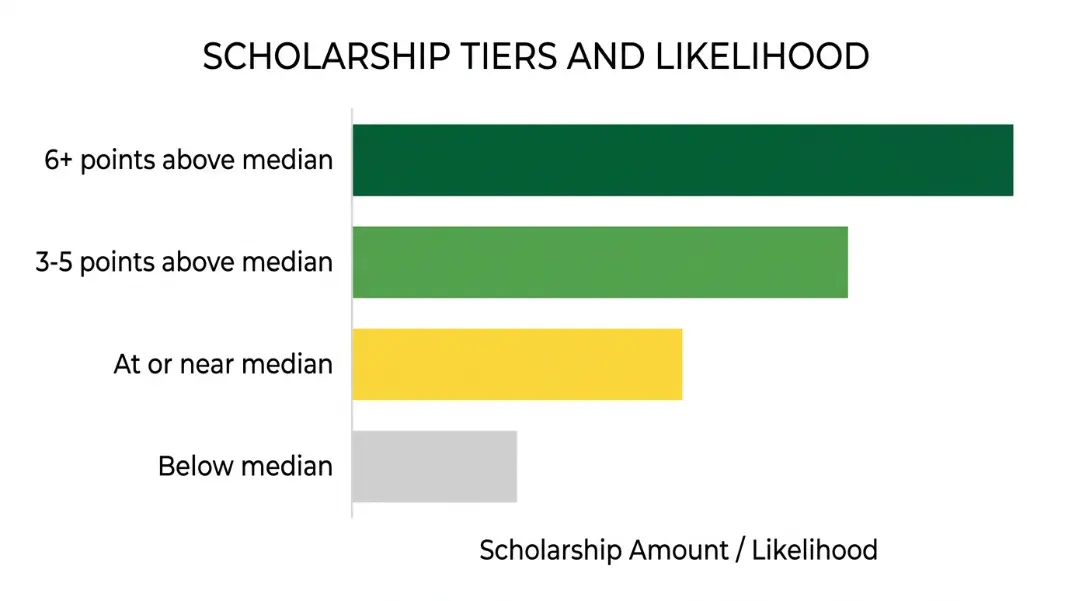
The most direct predictor of whether you receive a scholarship, and how large it will be, is how far your LSAT sits above a school's median. This is not a soft factor. It is the primary filter at most non-T14 programs.
The pattern across ABA-accredited schools is consistent enough to use as a planning baseline:
| Your LSAT vs. School Median | Typical Award Range |
|---|---|
| 6 or more points above (at or above 75th %ile) | Full tuition or near-full |
| 3 to 5 points above median | Half to two-thirds tuition |
| At or within 2 points of median | Small grant, not guaranteed |
| Below the median | Merit aid unlikely |
These are approximations, not guarantees. Schools allocate scholarship budgets differently, and timing within the admissions cycle matters. Schools that fill seats early in the rolling cycle often hold back less money for later applicants. Applying by November or December for the following fall typically puts you in the pool before the most competitive scholarship budget windows close.
Schools ranked 50 to 150 tend to be the most aggressive with awards because they compete most directly for applicants who have higher-ranked options. A 170 LSAT at a school with a 162 median will produce a substantial offer at nearly any program in that range. The same 170 at Yale generates no scholarship advantage because Yale's median is already 174.
For a full breakdown of which programs across tiers give the most awards and how renewal policies compare, the law schools with best scholarships guide has the complete comparison.
What Your LSAC GPA Controls in the Scholarship Decision#
The GPA component in law school admissions uses your LSAC GPA, which the Law School Admission Council calculates from all undergraduate coursework across every institution you attended. This figure often differs from your transcript GPA because LSAC includes coursework from schools you transferred away from and does not honor grade replacement for repeated courses. The LSAC GPA Calculator converts your transcripts into the LSAC scale so you know your actual number before applying.
For scholarship purposes, GPA plays a supporting role to LSAT at most non-T14 schools. A strong LSAT with a weak GPA can still generate significant scholarship offers at schools where your LSAT sits above the 75th percentile. The reverse, a strong GPA with a weak LSAT, is less consistently predictive of merit aid.
GPA gains more influence in two specific scenarios. First, at T14 schools where applicant LSAT scores are compressed into a narrow range, other factors including GPA, undergraduate institution, work experience, and narrative start to differentiate more meaningfully. Second, at programs with explicitly holistic review processes, where the full application package carries more weight in both admission and scholarship allocation.
For applicants targeting non-T14 scholarships, the practical takeaway is clear: retake the LSAT if your score is below the 75th percentile of your target schools. An additional LSAT point that crosses a school's 75th percentile threshold is worth more in scholarship dollars than almost any other change you can make at the application stage.
The Renewal Conditions That Catch Most Scholarship Holders Off Guard#
A scholarship offer is not a guaranteed three-year award. Most law school merit scholarships are conditional on maintaining a minimum GPA each year, and those conditions create difficulty in ways applicants do not anticipate when they sign.
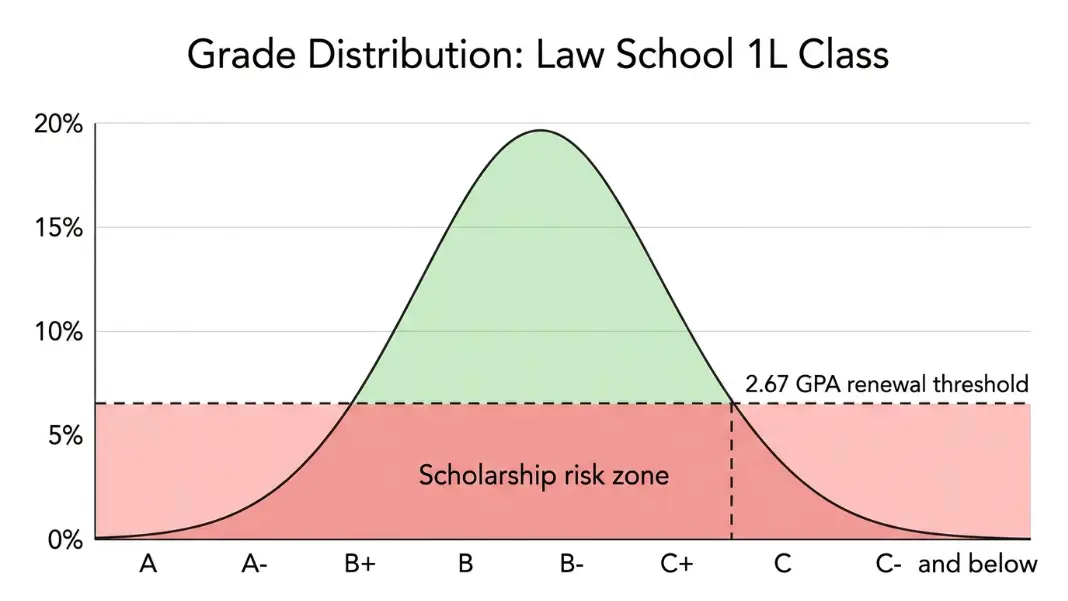
The typical renewal threshold is between 2.67 and 3.0, depending on the school. That range sounds achievable to applicants who have never received a grade below a B. The problem is the mandatory grade curve that most law schools impose on first-year courses.
Law schools typically set a required grade distribution for 1L classes. A common structure specifies that the median grade in any first-year course must fall at a B or B+, with a fixed percentage of the class receiving grades below a threshold. Every student in your 1L section was competitive enough to get in. Mandatory curves redistribute grades across that group regardless of absolute effort or performance.
In practice, 15 to 30 percent of any 1L class at schools with strict curves will receive grades that fall below a B average by the end of first semester. Some of those students entered on full scholarships.
The question to ask before signing any scholarship offer is direct: how many students in last year's 1L class retained their scholarship after first year? Some schools disclose this figure in their ABA 509 data. Others will answer if asked directly. Some states require disclosure. If an admissions office deflects or claims not to know, that tells you something worth weighing before you commit.
Once you have an offer in hand, the scholarship negotiation guide covers how to use a competing offer to improve the terms or push back on renewal conditions before the April decision deadline.
T14 vs. Lower-Ranked Schools: Where Full Scholarships Actually Come From#
The most consequential misunderstanding in law school scholarship planning is that better schools offer better scholarships. At the extremes of the ranking distribution, the opposite is true.
T14 law schools (Yale, Harvard, Stanford, Columbia, Chicago, NYU, Penn, Virginia, Duke, Northwestern, Cornell, Georgetown, Michigan, and Texas) offer far less per-student merit aid than schools ranked 20 through 100. Their employment outcomes attract applicants willing to take on full tuition debt. They receive more qualified applications per seat than any other tier and have little financial incentive to compete for individual students with large scholarship offers.
Full scholarships at T14 schools are uncommon. They appear in named endowment programs, occasionally in public interest fellowships, and sometimes when one T14 school uses a competing T14 offer to trigger negotiation. Expecting merit aid at a T14 without extraordinary LSAT numbers or a competing T14 offer is not a realistic baseline assumption.
Schools ranked 20 to 100 operate in a different environment. These schools compete against the T14 for their most attractive applicants and use scholarship dollars as the primary competitive tool. A 170 LSAT applicant who could attend Georgetown without aid becomes a realistic full-scholarship candidate at any school where 170 is above the 75th percentile. For a detailed breakdown of which school tiers offer full-tuition and full-ride awards and at what LSAT ranges, see the full ride law school scholarships guide.
Whether a full scholarship at a lower-ranked school makes sense financially depends on your specific career goals. For BigLaw in primary markets, rank affects on-campus interview access in ways a scholarship does not fully offset. For government work, regional practice, and public interest careers, the financial math typically favors taking the money.
Scholarship offers typically arrive with the admission decision at most schools. Programs using rolling admissions, which includes most ABA programs, send notifications throughout the fall and spring. Most applicants receive scholarship offers between January and March for fall enrollment. The acceptance deadline for most offers is April 15, which is also the window when competing offers are most useful in negotiation.
The LSAT Score Calculator shows your score's percentile position and helps you identify where you cross into above-75th-percentile territory at the schools you are considering, which is the starting point for building a scholarship-optimized list.
Law school merit scholarships are awarded based on your LSAT score and GPA relative to a school's current student medians. Schools use scholarship money to attract applicants who improve their ranking statistics, particularly median LSAT. Applicants above a school's 75th percentile LSAT are typically eligible for significant merit aid, often half to full tuition. Most law school merit aid requires no separate application and is not based on financial need.
Most ABA-accredited law schools award merit scholarships automatically based on your LSAT and GPA as part of the admission review. You do not submit a separate scholarship application at most programs. Some schools have named scholarship programs with separate processes, but the majority of merit aid is allocated based on index numbers and does not require additional materials beyond the standard admission application.
Most law school merit scholarships require a GPA between 2.67 and 3.0 each year to remain eligible. The challenge is that most law schools use mandatory grade curves that force a fixed grade distribution. Because every 1L student was competitive as an applicant, the curve means a real percentage of scholarship holders fall below the renewal threshold after first year. Ask any school you are considering how many 1L students retained their scholarship last year.
Most law schools send scholarship offers at the same time as, or within a few weeks of, the admission decision. Schools using rolling admissions send offers throughout the fall and spring cycle, with most arriving between January and March for fall enrollment. The acceptance deadline for most offers is April 15. That same window is when presenting competing offers from similar-ranked schools is most effective for negotiation.
Merit scholarships for below-median LSAT applicants are uncommon at most schools. Some programs factor in diversity, background, or undergraduate institution, which occasionally produces small grants for below-median applicants. A below-median LSAT with a strong GPA can sometimes generate a partial award at schools where GPA carries more weight in the index. In general, meaningful scholarship leverage requires at least matching, and preferably exceeding, the school's 75th percentile LSAT.
Getting a law school scholarship means applying to schools where your LSAT sits above their 75th percentile. The higher your numbers sit above a school's median, the more scholarship leverage you have. Apply across tiers, not just to reach schools. A full scholarship at a school where your LSAT is well above median often produces a better financial outcome than partial or no aid at a higher-ranked school, depending on your specific career goals.
Written by
Hassaan Rasheed
Web Developer & Content Researcher
Hassaan builds calculators and writes source-linked guides across the site's subject areas. Calculator methods and reference data are documented in each guide so readers can verify the underlying sources.
About the author and methods