How to Calculate Prorated Rent: Formula and Examples (2026)
Prorated rent = rent ÷ days in month × days occupied. Covers move-in, move-out, and mid-month examples, daily-rate method, and when landlords use a 30-day month.
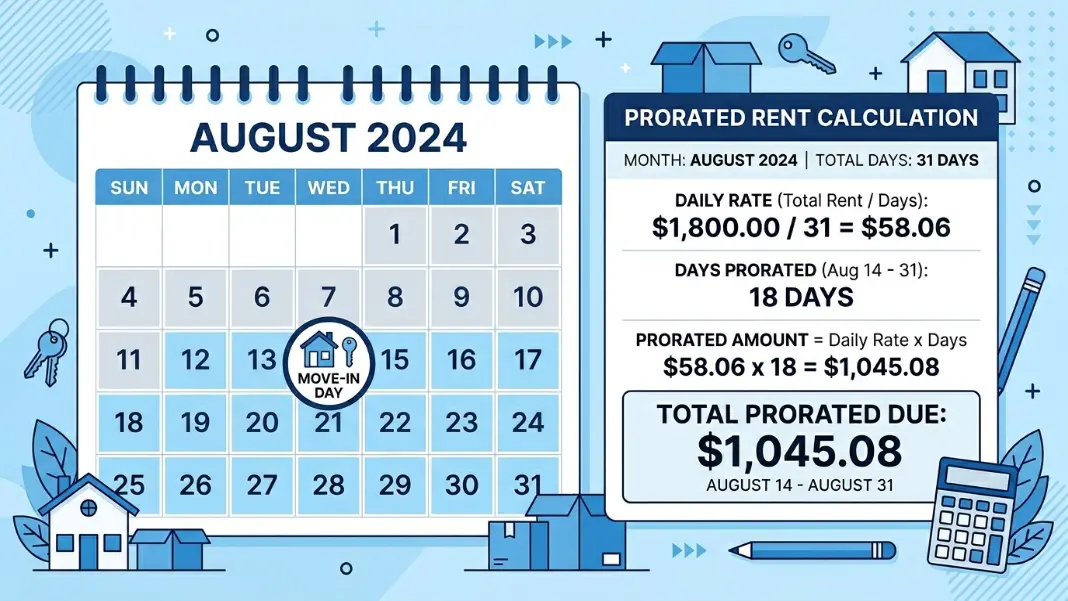
Prorated rent is the partial month's rent owed when a tenant moves in or out on a day other than the first or last day of the month. Landlords and tenants use it to settle the first and last partial months fairly without charging a full month for an incomplete occupancy period. The Prorated Rent Calculator handles any move date instantly. This guide covers the formula, worked examples for move-in and move-out, and why the month you move in affects what you owe.
Prorated Rent Formula: Daily Rate vs 30-Day Method#
Two formulas are in common use. The calendar day method uses the actual number of days in that specific month as the divisor. The 30-day method uses a flat 30 days regardless of month length.
Calendar day method (standard in most residential leases):
Daily Rate = Monthly Rent ÷ Days in the Month
Prorated Amount = Daily Rate × Days Occupied
30-day method (used in some commercial and month-to-month leases):
Daily Rate = Monthly Rent ÷ 30
Prorated Amount = Daily Rate × Days Occupied
The two methods produce different results in every month except a 30-day month. In February (28 days), the 30-day method gives a lower daily rate, which is cheaper for the tenant. In 31-day months, the 30-day method costs more per day.
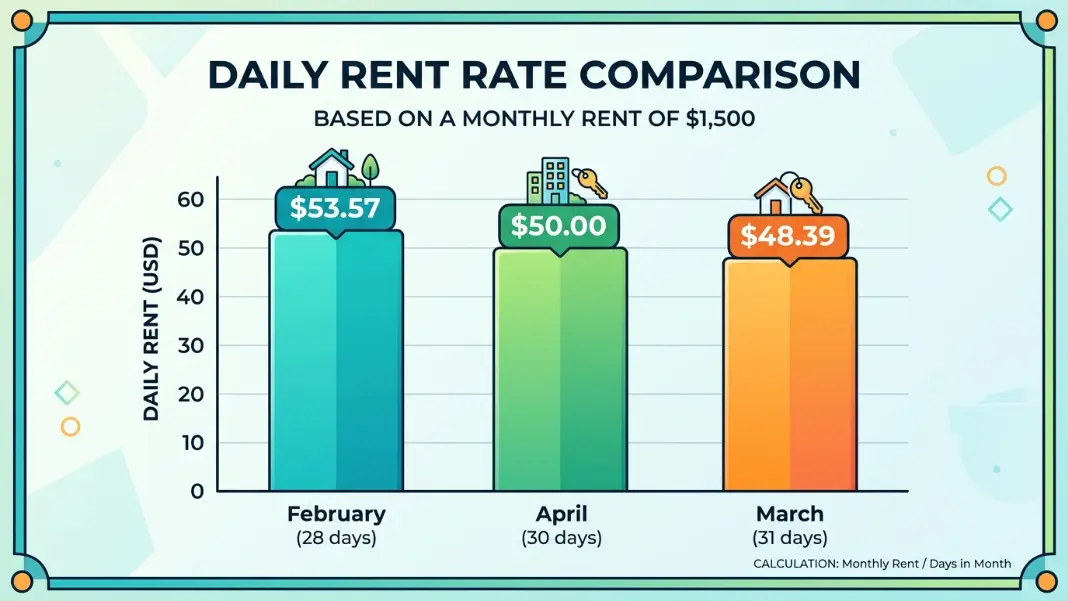
Comparison for a $1,500/month lease, 15-day move-in:
| Month | Days | Calendar Day Rate | 30-Day Rate | Calendar Prorate | 30-Day Prorate |
|---|---|---|---|---|---|
| February | 28 | $53.57 | $50.00 | $803.57 | $750.00 |
| April | 30 | $50.00 | $50.00 | $750.00 | $750.00 |
| March | 31 | $48.39 | $50.00 | $725.81 | $750.00 |
Check your lease to confirm which method applies. Most residential leases default to the calendar day method. If the lease does not specify, the calendar day method is the legal standard in most jurisdictions.
How to Calculate Prorated Rent for Move-In Day#
Move-in proration covers the first partial month when possession begins on any day other than the 1st.
Step-by-step:
- Identify the move-in date
- Count the days from move-in through the last day of the month, including both endpoints
- Divide monthly rent by days in that calendar month
- Multiply by days occupied
Move-in example: September 20
- Monthly rent: $2,200
- Days in September: 30
- Days occupied: Sept 20 through Sept 30 = 11 days (count both endpoints)
Daily Rate = $2,200 ÷ 30 = $73.33
Prorated Amount = $73.33 × 11 = $806.67
The tenant owes $806.67 at move-in, then $2,200 per month starting October 1.
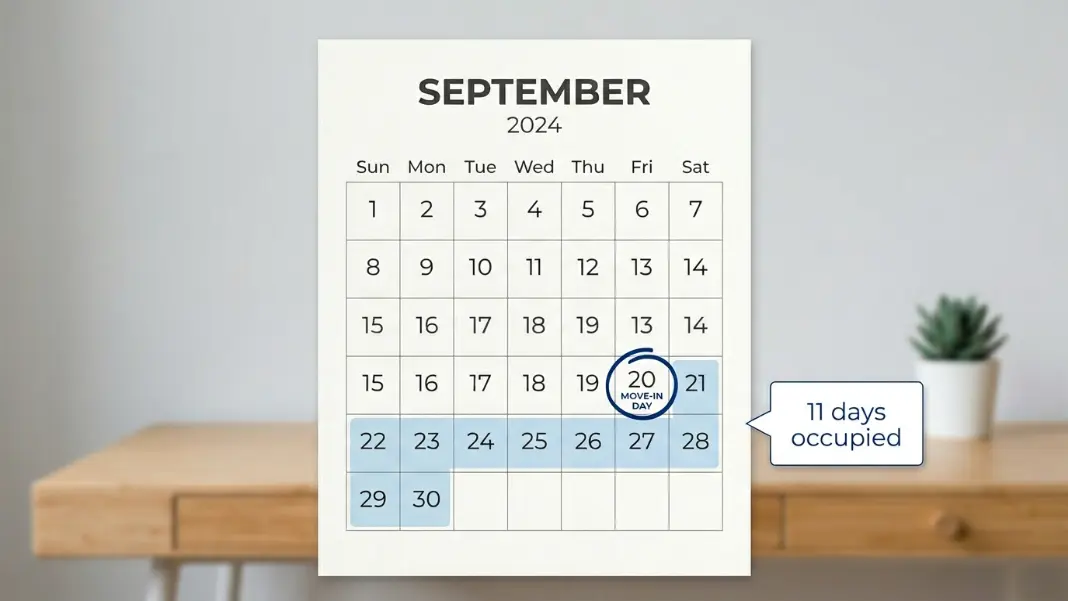
The most common counting error: If you move in September 20, the occupied days are 20, 21, 22, 23, 24, 25, 26, 27, 28, 29, 30, totaling 11 days. Subtracting 20 from 30 gives 10, which is wrong. Always count the move-in day as an occupied day.
Move-in example: December 28
- Monthly rent: $1,750
- Days in December: 31
- Days occupied: Dec 28, 29, 30, 31 = 4 days
Daily Rate = $1,750 ÷ 31 = $56.45
Prorated Amount = $56.45 × 4 = $225.81
Moving in on December 28 means owing just $225.81 for December, then $1,750 starting January 1.
Move-in on the 1st: No proration. The tenant pays a full month.
Prorated Rent for Move-Out: Last Partial Month Calculation#
Move-out proration applies when a tenant vacates before the last day of the month and both parties agree to prorate the final month. The math mirrors the move-in method.
Move-out example: April 18
- Monthly rent: $1,800
- Days in April: 30
- Days occupied in April: April 1 through April 18 = 18 days
Daily Rate = $1,800 ÷ 30 = $60.00
Prorated Amount = $60.00 × 18 = $1,080.00
If the tenant paid a full month at the start of April, the landlord credits $720.00 back at move-out ($1,800 minus $1,080).
Move-out example: February 15
- Monthly rent: $1,650
- Days in February: 28
- Days occupied: 15
Daily Rate = $1,650 ÷ 28 = $58.93
Prorated Amount = $58.93 × 15 = $883.93
Credit owed: $1,650 - $883.93 = $766.07
Move-out on the last day of the month: No proration owed. A tenant leaving on March 31 or June 30 pays a full month.
For commercial tenants, base rent proration follows the same daily rate formula, but operating expense reconciliations and percentage rent clauses use separate calculations. The Commercial Mortgage Calculator shows how lenders evaluate the property income that landlords use to set base rent in commercial leases.
Why February Produces the Highest Daily Rent Rate#
February has 28 days (29 in a leap year), the fewest of any month. Because daily rate = rent divided by days in the month, the shorter the month, the higher the daily rate.
Daily rent comparison for a $2,000/month lease:
| Month | Days | Daily Rate | 15-Day Prorate |
|---|---|---|---|
| February (non-leap) | 28 | $71.43 | $1,071.43 |
| February (leap year) | 29 | $68.97 | $1,034.48 |
| April, June, September, November | 30 | $66.67 | $1,000.00 |
| January, March, May, July, August, October, December | 31 | $64.52 | $967.74 |
A February 15 move-in at $2,000/month costs $103.69 more than the same move-in date in a 31-day month. Tenants who have flexibility in their move date can reduce first-month costs by targeting a 31-day month.
Leap year February (29 days) is cheaper per day than non-leap February but still more expensive than any other month. The difference for a $2,000 lease over 15 days between leap and non-leap February is $36.95.
Prorated Rent Template: What the Calculation Should Document#
A written prorated rent breakdown should include four elements to prevent disputes at move-out:
1. Monthly rent amount: the agreed base rent in the lease
2. Move-in or move-out date: exact calendar date
3. Calculation method: calendar day or 30-day, referencing the lease clause if possible
4. Prorated amount: the dollar figure with the math shown
Example written breakdown:
Tenancy begins: August 14, 2026
Monthly rent: $1,950
Days in August: 31
Days occupied in August: Aug 14-31 = 18 days
Daily rate: $1,950 ÷ 31 = $62.90
Prorated rent due at signing: $62.90 × 18 = $1,132.26
First full month: $1,950 due September 1, 2026
Keeping this record matters if a security deposit dispute arises later. When move-in costs (prorated rent plus deposit plus first full month) add up to several thousand dollars, using a Debt Snowball approach to clear high-interest balances before signing a new lease reduces total financial pressure in the first 60 days of tenancy.
When Prorated Rent Does Not Apply#
Three situations where partial-month proration either does not arise or works differently:
Fixed-term leases starting mid-month by design. If a lease runs explicitly from June 15 through June 14 the following year, rent is structured around that cycle. There is no partial first month to prorate.
Weekly or daily rental agreements. Short-term rentals priced per week or per day are already denominated in sub-monthly units. No monthly-to-daily conversion is needed.
Commercial NNN leases. Triple-net leases prorate base rent at move-in the same way as residential leases. However, operating expense estimates (property taxes, insurance, maintenance) billed monthly as additional rent are reconciled at year-end based on occupancy percentage, not a daily rate.
Divide monthly rent by the number of days in that calendar month to get the daily rate. Multiply by days occupied, counting both the move-in day and the last day of the month. For a $1,500/month lease with a June 20 move-in: $1,500 ÷ 30 = $50/day × 11 days (June 20-30) = $550. The Prorated Rent Calculator runs any date combination automatically.
The calendar day method divides by the actual days in that specific month (28, 29, 30, or 31). The 30-day method always divides by 30. In February, the 30-day method produces a lower daily rate and favors the tenant. In 31-day months, the 30-day method is more expensive per day. Most residential leases use the calendar day method. Your lease should specify which applies.
Count the days you occupied the unit during the final partial month, from the 1st through your move-out day inclusive. Multiply by the daily rate (monthly rent divided by days in that month). If rent was paid in full, the landlord credits the remaining unoccupied days. For a $1,800/month April lease with a move-out on April 18: $1,800 ÷ 30 = $60/day × 18 days = $1,080 owed, so the landlord credits $720.
Prorated rent covers base rent only, unless your lease bundles utilities into rent as a single flat amount. Separately billed utilities (electric, gas, water) are not prorated because they are metered from your actual occupancy date. If a flat utility fee is written into the total monthly rent figure in the lease, it is prorated at the same daily rate as the base rent.
Count every calendar day from your move-in date through the last day of the month, inclusive of both endpoints. Moving in on August 22 means occupying August 22, 23, 24, 25, 26, 27, 28, 29, 30, and 31, totaling 10 days. The most common error is subtracting dates (31 minus 22 = 9) instead of counting inclusively, which undercounts by one day.
31-day months (January, March, May, July, August, October, December) produce the lowest daily rate for a given monthly rent because the divisor is highest at 31. February produces the highest daily rate because the divisor drops to 28. For a $2,000/month lease with a 15-day move-in, the 31-day month prorate is $967.74 versus $1,071.43 in a non-leap February, a $103.69 difference for the same number of days occupied.
Written by
Hassaan Rasheed
Web Developer & Content Researcher
Hassaan builds calculators and writes source-linked guides across the site's subject areas. Calculator methods and reference data are documented in each guide so readers can verify the underlying sources.
About the author and methods