California Paycheck Laws: Pay Frequency, Stubs, Deductions, and Your Rights (2026)
California paycheck laws: how often employers must pay, what every pay stub requires, legal vs illegal deductions, and penalties for late regular paychecks under Labor Code 210.
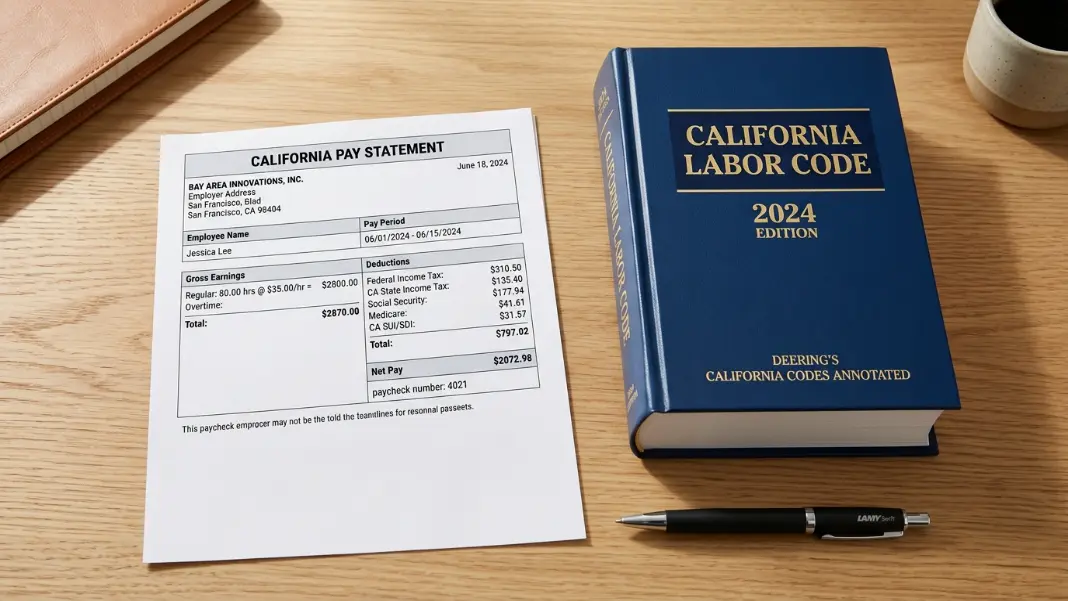
California paycheck law covers more ground than most employees realize, and most of that ignorance costs workers money. Employers who miss pay dates face real financial penalties. Employees who accept illegal deductions or receive stub-less paychecks have rights they are not exercising. If you have ever held a California paycheck and wondered whether what you were paid, when you were paid, and what was taken out were all legal, this guide answers those questions in full.
Start by knowing what your gross pay and deductions should look like before you even receive the check. The California Paycheck Calculator lets you model any salary or hourly rate across any pay period and see the full federal and state withholding breakdown, so you have a number to compare against what your employer actually sends you.
California Pay Frequency Requirements: How Often Employers Must Issue Paychecks#
California Labor Code 204 sets the baseline pay frequency rules, and those rules vary depending on whether an employee is classified as exempt or non-exempt. Getting this wrong is one of the more common payroll violations, partly because employers sometimes try to apply the more lenient exempt-employee rules to workers who should be treated as non-exempt.
Non-exempt employees (including most hourly workers):
Non-exempt employees must be paid at least twice per month. That semimonthly requirement means at minimum two paydays per calendar month, and those days must be designated in advance. The employer does not have complete discretion to choose any two days on a whim. Specifically, California requires that wages earned between the 1st and the 15th of the month must be paid no later than the 26th of that month, and wages earned between the 16th and the last day of the month must be paid no later than the 10th of the following month. Those are outer limits. Employers can establish more frequent pay cycles, such as weekly or biweekly, but they cannot pay less frequently than semimonthly for non-exempt employees.
For newly hired non-exempt employees, the first payday must fall within 7 days of the end of the first pay period. A new employee who starts on a Monday and whose first pay period runs through the following Sunday should expect their first check within 7 days of that Sunday.
Exempt employees (executive, administrative, professional):
Exempt employees classified under the California executive, administrative, or professional exemptions can be paid monthly. That is the legal minimum. Most California employers pay exempt salaried employees biweekly or semimonthly as a practical matter, but the law does not require it as long as payment happens at least once per month.
Holiday payday rules:
When a designated payday falls on a holiday, the employer has the option to pay on the preceding business day. Note the direction carefully: preceding, not following. Paying one business day later when a payday falls on a holiday is a violation. The employer must pay early or on time, not late.
Posting requirements:
Labor Code 207 requires employers to post their paydays in a conspicuous location in the workplace. This is not a technicality. An employer who has not posted designated paydays has failed to meet a baseline legal obligation, which matters if a dispute ever arises about whether an employee was properly notified of their pay schedule.
How this interacts with overtime:
For hourly employees who work beyond 8 hours in a day or 40 hours in a week, overtime pay is earned in the same pay period as the regular hours and must be included in that period's paycheck. California overtime does not carry forward. If you are calculating what your overtime pay should look like, the Time and a Half Calculator handles California's daily overtime rules, including the double-time threshold that kicks in after 12 hours in a single workday.
What California Law Requires on Every Pay Stub (Labor Code 226)#
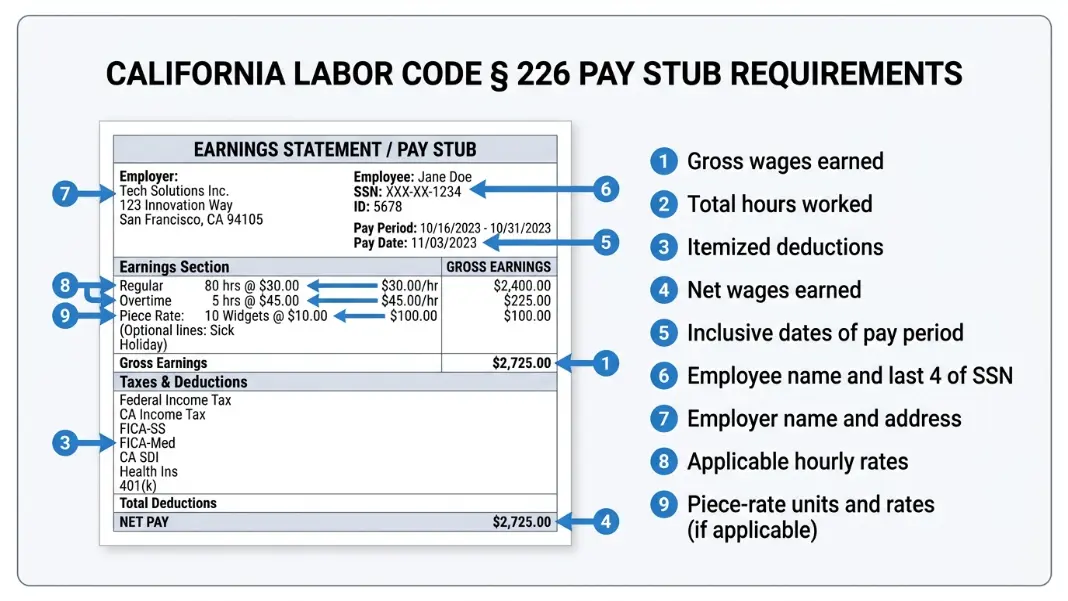
This section is where most payroll violations hide in plain sight. California Labor Code 226 requires that every wage statement, meaning every pay stub or pay record provided to an employee, contain nine specific categories of information. Not eight. Not approximately nine. Exactly these nine items, all present, all accurate.
The 9 required items under Labor Code 226:
1. Gross wages earned. The total amount of wages earned before any deductions. This is the starting number from which everything else flows.
2. Total hours worked for non-exempt employees. Exempt salaried employees are not required to have hours tracked on their stub, but every non-exempt employee must see their total hours worked for that pay period. Suppressing this number is a violation.
3. Piece-rate units earned and the applicable rate, if the employee is paid on a piece-rate basis. If compensation is based on units produced rather than hours worked, both the unit count and the per-unit rate must appear.
4. All deductions, itemized. Every single deduction must be listed separately. A line that says "deductions: $450" without breaking that down into federal withholding, California state income tax, SDI, health insurance, and any other deductions is a violation. Itemization is the requirement, not a summary.
5. Net wages earned. The take-home amount after all deductions. This should be mathematically reconcilable against gross wages and the itemized deductions above it.
6. The inclusive pay period dates. Both the start date and end date of the pay period being covered by this paycheck must appear. This establishes the window of time the stub represents.
7. Employee name and last four digits of Social Security number, or an employee ID number. The full Social Security number must not appear on the pay stub. Only the last four digits are permissible, or an employee identification number the employer assigns internally. This protects against identity theft while still allowing identification.
8. Employer's legal name and address. The name as it appears on legal filings, not a trade name or DBA, along with the physical address of the employer's principal place of business or the address of the hiring entity.
9. All hourly rates in effect during the pay period and the corresponding hours worked at each rate. If an employee earned $18/hour for 32 hours and $27/hour (overtime) for 10 hours in a single pay period, both rates and their corresponding hours must appear separately. This is particularly important for employees who work at multiple pay rates or who transitioned to a different rate mid-period.
Penalties for pay stub violations under Labor Code 226:
An employer who fails to provide an accurate, itemized wage statement faces statutory penalties even if the underlying wages were paid correctly. The first violation costs $50 per employee. Each subsequent violation costs $100 per employee. The maximum penalty is $4,000 per employee across all violations. These penalties apply per instance, so an employer who is missing required information across 12 consecutive pay periods for 20 employees is looking at significant cumulative exposure.
Employees can bring a civil action to recover these penalties and are entitled to attorney's fees if they prevail. The penalties are separate from any wage claim for unpaid wages.
Electronic pay stubs:
California law permits employers to issue pay stubs electronically, provided the employee can access and print the electronic record. Employees who prefer paper stubs can request them, and some employers in certain industries are required to provide paper stubs automatically. An employer cannot refuse a reasonable request for a printable record.
Lawful and Unlawful Deductions From a California Paycheck#
California takes a stricter position on paycheck deductions than federal law does. The federal Fair Labor Standards Act allows many deductions that California prohibits outright. An employer operating in California who relies on federal standards without checking California's additional restrictions is likely running illegal payroll.
The core principle in California is that wages are the property of the employee once earned. Employers cannot use the paycheck as a mechanism to shift business costs or risks onto the employee.
Deductions that are lawful in California:
Federal and state income tax withholding is required by law and does not require any separate employee authorization. FICA, which covers Social Security and Medicare, is also mandatory and withheld automatically. California SDI, the state disability insurance contribution, is deducted from all covered employees without individual election.
Court-ordered wage garnishments are lawful, subject to the limits the garnishment order specifies. Employers who receive a valid garnishment order must comply. The employee cannot instruct the employer to ignore a court order.
Beyond mandatory deductions, employers may make additional deductions only with the employee's prior written authorization. Health insurance premiums, contributions to a 401(k) or similar retirement plan, voluntary life insurance premiums, flexible spending account contributions, and charitable donations can all be deducted if the employee has signed a specific written agreement authorizing each one. A general onboarding form that references deductions vaguely is not sufficient. The authorization must identify the specific deduction, the amount or the basis for calculating it, and it must be voluntary, meaning the employee agreed to it freely without being required to sign as a condition of employment.
For a detailed look at how all these layers interact and what your actual take-home looks like, the California Paycheck Tax Guide walks through every major withholding category with rate tables and worked examples.
Deductions that are unlawful in California:
California law prohibits several categories of deductions that employers in other states might consider routine.
Cash register shortages cannot be deducted from wages unless the employee had sole control and sole accountability over the register. If multiple employees share access to a register or till, the employer cannot deduct a shortage from any one of them. The employer bears the risk of cash handling losses unless a single employee had exclusive control and that control can be documented.
Equipment breakage and property damage cannot be deducted from wages unless the employee was grossly negligent or acted willfully. Normal wear, ordinary accidents, and mistakes that any reasonable employee might make are all costs of doing business that the employer must absorb. The California Supreme Court has been clear that the economic risks of an employer's business cannot be passed to employees through paycheck deductions.
Uniforms, tools, and equipment required for the job are the employer's responsibility. If the employer requires a specific uniform, the employer must pay for it. If the job requires specific tools, the employer must provide them or reimburse the cost. Deducting the cost of a required uniform from wages is a violation.
Business expenses paid by an employee must be reimbursed under Labor Code 2802. An employer who requires employees to use their personal vehicles, personal phones, or personal equipment for work must reimburse those costs. Failing to reimburse and then characterizing the gap as a deduction is doubly illegal.
Bad check losses cannot be passed to employees. If a customer pays with a check that bounces, that is the employer's business risk.
Pre-employment medical examinations required by the employer as a condition of hiring must be paid for by the employer. An employer cannot require a medical exam, make hiring contingent on passing it, and then deduct the exam cost from the employee's first paycheck.
Penalties for Late Regular Paychecks in California (Labor Code 210)#
Most people who know anything about California paycheck penalties know about Labor Code 203, the waiting time penalty for late final paychecks. Those penalties are serious and they go directly to the employee. But Labor Code 210 is a different statute covering a different situation, and the two are frequently confused.
Labor Code 210 applies to late regular paychecks. If you are still employed and your employer misses your regular payday or pays you less than the full amount owed, that is a Labor Code 210 violation, not a Labor Code 203 violation.
The penalty structure under Labor Code 210:
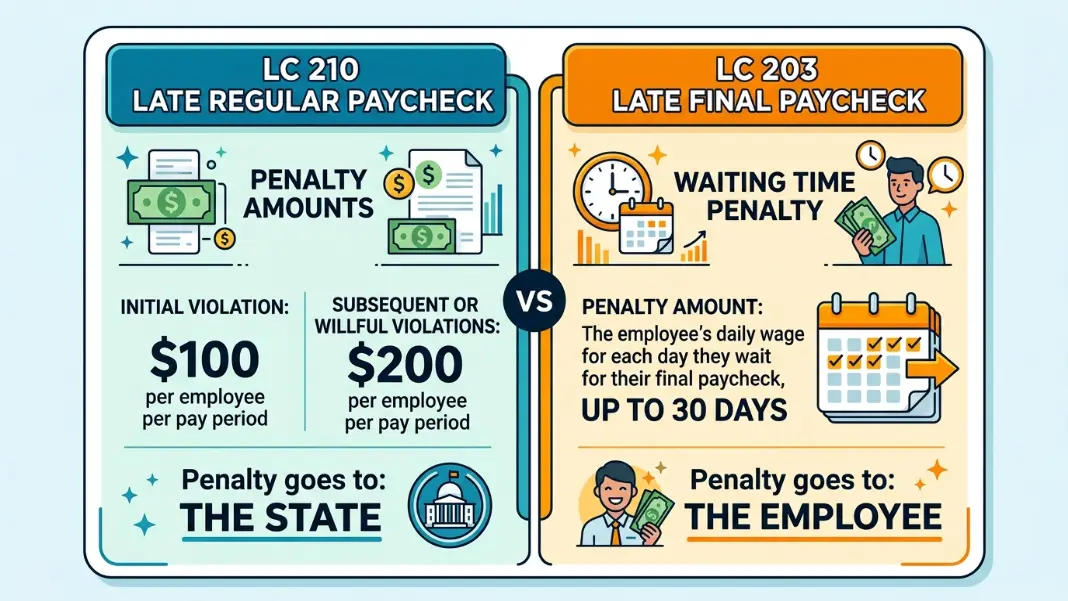
The first violation carries a penalty of $100 per employee. If the same employer repeats the late payment violation, the penalty increases to $200 per employee plus 25% of the amount that was unlawfully withheld. The 25% add-on is calculated against the actual wages that were late, which means a larger delayed payment produces a larger penalty multiplier.
A critical distinction from final paycheck penalties:
Here is the part that surprises most people who have read about California paycheck law: Labor Code 210 penalties go to the state, not to the employee. This is fundamentally different from the waiting time penalties under Labor Code 203, which are paid directly to the employee as additional wages equal to one day's pay for each day the final paycheck is late, up to 30 days.
Under Labor Code 210, the employee who received the late paycheck does not personally collect the penalty amount. The state collects it. The employee can file a complaint with the Division of Labor Standards Enforcement, which investigates and can assess those penalties against the employer, but the money flows to the Labor Commissioner's office rather than to the employee's bank account.
What employees do recover directly, in addition to filing a Labor Code 210 complaint, is the underlying unpaid or late wages themselves. If your employer paid you $1,200 late and $300 short, you are owed that $300 in unpaid wages regardless of who collects the statutory penalty.
This distinction matters because employees who are waiting on a late regular paycheck sometimes believe they are earning waiting time penalties at the same daily rate that applies to final paychecks. That is not the case for an ongoing employment relationship. The waiting time penalty accrual under Labor Code 203 applies only when the employment has ended and the employer is late on the final check.
For complete details on final paycheck timing, the separate penalty calculations under Labor Code 203, and what happens when an employer disputes the amount of a final check, see the California Final Paycheck Law guide. That piece covers termination versus resignation scenarios, how the waiting time penalty is calculated day by day, and how to file a claim if your final paycheck is late or short.
Filing a complaint for a late regular paycheck:
An employee who is owed wages from a late regular paycheck can file a wage claim with the California Labor Commissioner's office, also known as the Division of Labor Standards Enforcement (DLSE). The DLSE investigates the claim and holds a hearing if the facts are contested. If the employer is found to have violated Labor Code 204 (pay frequency) or Labor Code 210 (timely payment), the Commissioner can assess penalties and order payment of any outstanding wages. There is no filing fee for a wage claim.
Employees also have the option of filing a civil lawsuit for unpaid wages, particularly in cases involving significant amounts or patterns of conduct that may qualify for class action treatment.
California Minimum Wage, Pay Transparency, and Additional Employer Obligations#
California's minimum wage framework is no longer a single number. As of 2026, the statewide minimum is $16.50 per hour, which applies to most workers in California who are not covered by a higher industry-specific or local rate.
Industry-specific minimums:
Fast food workers at covered chains are subject to the $20 per hour minimum established by AB 1228, which took effect April 1, 2024. That rate was set with a mechanism for annual adjustments, and any 2026 update to that rate would apply to fast food restaurant workers at chains with more than 60 locations nationally.
Healthcare workers are on a phased schedule of increases. Some healthcare classifications reached $25 per hour by 2026, with additional phases continuing toward broader coverage at $25 per hour by 2028, depending on facility type and role. The specific rate for a given healthcare employee depends on the employer's size and type, so the applicable minimum must be checked against the relevant health care minimum wage schedule.
Local minimum wages:
City and county minimums in California exceed the state floor by varying amounts. Los Angeles City is at $17.28 per hour as of mid-2026. San Francisco, which adjusts its minimum annually on July 1 based on the regional Consumer Price Index, reached $18.67 per hour. These local rates apply to employees who perform work within those jurisdictions, not just those who live there. An employer based outside San Francisco who sends workers into the city must pay the San Francisco minimum for those hours.
Pay transparency under SB 1162:
California Senate Bill 1162 took effect January 1, 2023, and requires employers with 15 or more employees to include pay scale information in all job postings. This means the range of pay the employer reasonably expects to pay for the role must appear in the posting, whether it is posted on the company website, a job board, or any other medium. The pay transparency requirement applies to remote roles too, if a California applicant could be hired into the position.
Existing employees have the right to request the pay scale for their current position, and employers must provide it in writing within a reasonable timeframe.
Record retention and employee access:
California employers are required to retain payroll records, including wage statements, for a minimum of three years. Employees have the right to inspect their own payroll records upon request, and the employer must make those records available within 21 calendar days of a written request. Failure to provide timely access is itself a violation subject to a $750 penalty.
If you have never requested your own payroll records and you want to verify that your employer has been calculating your deductions correctly, this is a right you can exercise. Pull 12 months of records and check each one against the Labor Code 226 requirements above. Errors compound over time, and catching them early gives you the strongest position for recovery.
Knowing what the law requires on your paycheck, when it must arrive, and what your employer can and cannot take out of it changes how you read every stub you receive. Most employees who are being shorted or illegally docked do not know they have a claim because they have never seen the list of what California law actually prohibits. The deduction rules in particular, especially the restrictions on equipment damage, cash shortages, and uniform costs, go well beyond what most workers assume is normal.
If you want to verify that what you are seeing on your stub lines up with what California law allows, the California Paycheck Calculator gives you the gross-to-net breakdown for your specific income, filing status, and pay period. Run your own numbers and compare. That comparison is where most payroll errors surface.
Non-exempt employees in California must be paid at least twice per month (semimonthly), on designated paydays that must be posted in the workplace. Wages earned from the 1st through the 15th must be paid by the 26th of that month. Wages earned from the 16th through the last day of the month must be paid by the 10th of the following month. Exempt executive, administrative, and professional employees may be paid monthly.
California Labor Code 226 requires nine specific items on every wage statement: gross wages earned, total hours worked (for non-exempt employees), piece-rate units and rate if applicable, all deductions itemized, net wages earned, the pay period start and end dates, the employee's name and last four digits of their Social Security number or an employee ID, the employer's legal name and address, and all hourly rates in effect during the pay period along with corresponding hours worked at each rate.
Generally, no. California prohibits deductions for equipment breakage or damage to property unless the employee was grossly negligent or acted willfully. Ordinary accidents, mistakes, and normal wear are treated as business costs that the employer must bear. Deducting those losses from wages is unlawful. The same prohibition extends to cash register shortages when more than one employee had access to the register.
For a late regular paycheck (while employment is ongoing), Labor Code 210 sets a $100 penalty per employee for the first violation and $200 per employee plus 25% of the withheld amount for subsequent violations. These penalties go to the state, not directly to the employee. The employee can file a complaint with the California Labor Commissioner to trigger an investigation. Note that these are different from the Labor Code 203 waiting time penalties for late final paychecks, which go directly to the employee.
Only for exempt employees classified under the executive, administrative, or professional exemptions. Monthly pay is the legal minimum allowed for those categories. Non-exempt employees, including most hourly workers, must be paid at least semimonthly (twice per month). Paying a non-exempt employee monthly, even with their consent, is a violation of California Labor Code 204.
The California statewide minimum wage is $16.50 per hour in 2026. Fast food workers at covered national chains are subject to a $20 per hour minimum under AB 1228. Some healthcare workers are on a phased schedule that reaches $25 per hour for certain roles by 2028. Local minimums vary: Los Angeles City is at $17.28 per hour and San Francisco is at $18.67 per hour as of mid-2026. The applicable rate depends on where the employee performs the work.
Written by
Hassaan Rasheed
Web Developer & Content Researcher
Hassaan builds calculators and writes source-linked guides across the site's subject areas. Calculator methods and reference data are documented in each guide so readers can verify the underlying sources.
About the author and methods