Alaska, Hawaii, Idaho, and Kentucky Paycheck Tax Guide 2025
Alaska has no state income tax. Hawaii's top rate reaches 11%. Idaho went flat at 5.8% in 2023. Kentucky cut to 4.0%. Take-home pay at $50K, $75K, and $100K compared.
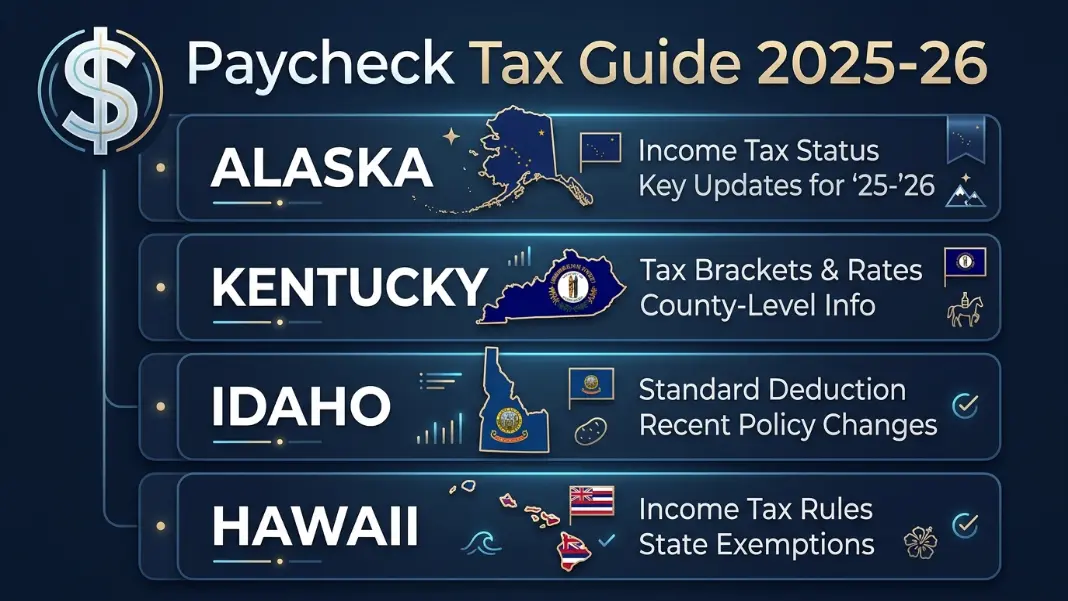
Four states that span nearly the full range of US income tax policy. Alaska levies no state income tax at all. Hawaii's top bracket reaches 11%, the highest rate in the country. Idaho abandoned a seven-bracket progressive system in 2023 and went flat at 5.8%. Kentucky cut its flat rate to 4.0% the same year.
If you are comparing take-home pay across these states for a job offer or a move, the calculators run the exact numbers: Alaska Paycheck Calculator, Hawaii Paycheck Calculator, Idaho Paycheck Calculator, Kentucky Paycheck Calculator. This guide shows what the rates look like side by side.
State Income Tax Rates: All Four States#
Alaska:
Alaska has no state income tax. There are no brackets, no flat rate, and no withholding on wages for state purposes. Alaska is one of nine states with no income tax, alongside Florida, Nevada, New Hampshire, South Dakota, Tennessee, Texas, Washington, and Wyoming.
Alaska distributes the Alaska Permanent Fund Dividend (PFD) to eligible residents each year. The 2024 PFD was $1,702 per eligible resident. This payment is taxable at the federal level but does not affect state income tax because there is none.
Hawaii 2025 (single filer, after $2,200 standard deduction):
| Taxable Income | Rate |
|---|---|
| Up to $2,400 | 1.4% |
| $2,401 to $4,800 | 3.2% |
| $4,801 to $9,600 | 5.5% |
| $9,601 to $14,400 | 6.4% |
| $14,401 to $19,200 | 6.8% |
| $19,201 to $24,000 | 7.2% |
| $24,001 to $36,000 | 7.6% |
| $36,001 to $48,000 | 7.9% |
| $48,001 to $150,000 | 8.25% |
| $150,001 to $175,000 | 9.0% |
| $175,001 to $200,000 | 10.0% |
| Over $200,000 | 11.0% |
Hawaii's 12-bracket structure is the most complex in the country and produces the highest effective tax rates of any state for middle and upper-middle incomes.
Idaho 2025:
Idaho replaced a seven-bracket progressive system with a single flat rate of 5.8% in 2023. Taxable income is gross income minus the federal standard deduction ($15,000 for single filers in 2025). Idaho provides a $120 grocery credit for lower-income filers, which phases out at higher incomes and does not apply to workers at $50,000 or above.
Kentucky 2025:
Kentucky cut its flat income tax rate from 4.5% to 4.0% in 2023. The state applies a standard deduction of $3,160 for single filers. All taxable income above that threshold is taxed at the flat 4.0% rate.
Kentucky also has local occupational taxes in several jurisdictions. Louisville Jefferson County charges 1.45% on wages for residents and workers. Lexington-Fayette charges 2.25%. Workers in those areas pay both the 4.0% state rate and the local occupational tax on top.
Take-Home Pay at $50K, $75K, and $100K#
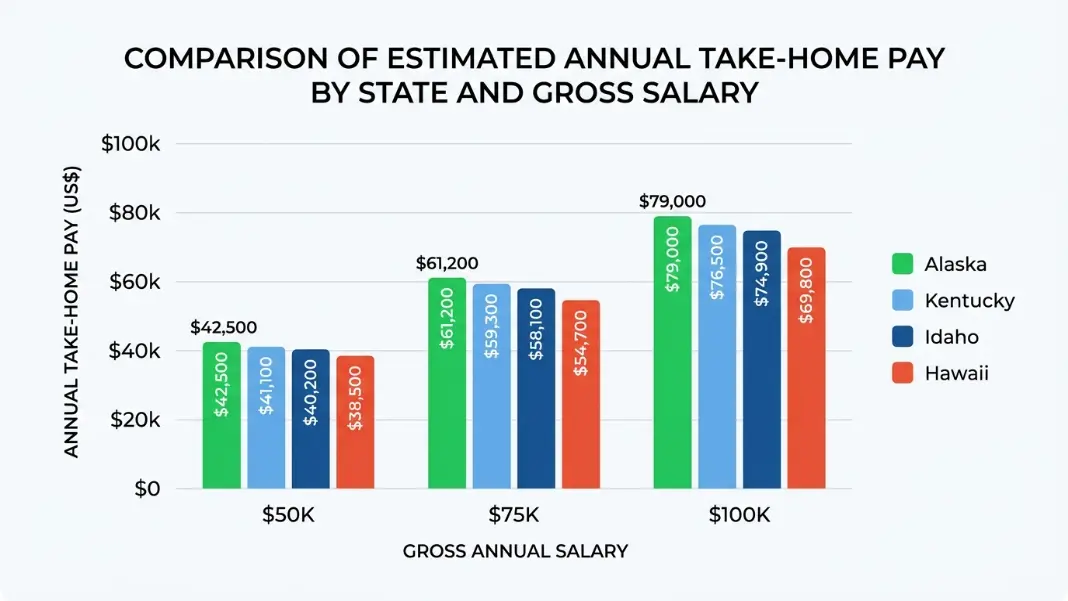
These figures use 2025 rates, single filing status, no pre-tax deductions, and no local taxes. Federal income tax uses the IRS 2025 brackets. The example FICA amount uses 6.2% Social Security up to the 2025 wage base plus 1.45% Medicare; Additional Medicare Tax is not included.
At $50,000 gross salary:
| State | Annual State Tax | Effective State Rate | Annual Take-Home |
|---|---|---|---|
| Alaska | $0 | 0% | $40,881 |
| Kentucky | $1,874 | 3.75% | $39,007 |
| Idaho | $2,030 | 4.06% | $38,851 |
| Hawaii | $3,198 | 6.40% | $37,683 |
At $75,000 gross salary:
| State | Annual State Tax | Effective State Rate | Annual Take-Home |
|---|---|---|---|
| Alaska | $0 | 0% | $58,968 |
| Kentucky | $2,874 | 3.83% | $56,094 |
| Idaho | $3,480 | 4.64% | $55,488 |
| Hawaii | $5,260 | 7.01% | $53,708 |
At $100,000 gross salary:
| State | Annual State Tax | Effective State Rate | Annual Take-Home |
|---|---|---|---|
| Alaska | $0 | 0% | $76,106 |
| Kentucky | $3,874 | 3.87% | $72,232 |
| Idaho | $4,930 | 4.93% | $71,176 |
| Hawaii | $7,322 | 7.32% | $68,784 |
The Alaska advantage grows with income because there is no state tax to apply. At $100K, an Alaska worker takes home $7,322 more than a comparable Hawaii worker and $4,930 more than an Idaho worker annually, on state taxes alone, before any local tax differences.
Alaska: No State Tax, but Cost of Living Matters#
Alaska workers keep every dollar that other states would withhold for income tax. But Anchorage and many Alaska cities consistently rank among the most expensive in the US. Groceries cost 30% to 50% more than the national average in many Alaska communities. Housing in Anchorage runs comparable to major Pacific Northwest cities.
The net financial advantage of zero state income tax depends on where you live within the state and what you spend. A $5,000 annual state tax saving can be absorbed by the cost-of-living difference within months for households spending heavily on food and housing.
The annual PFD adds back a meaningful amount for families. At the 2024 rate of $1,702 per eligible resident, a household of four received $6,808. That partially offsets higher living costs and is one reason Alaska remains financially competitive for families despite the expense.
Hawaii: The 8.25% Bracket Starts at $48,001#
Most middle-income earners in Hawaii hit the 8.25% bracket. That bracket begins at $48,001 of taxable income, which corresponds to a gross salary of roughly $50,200 after Hawaii's $2,200 standard deduction. Any worker earning above $50,200 gross is paying 8.25% on the majority of their state-taxable income.
Hawaii's $2,200 standard deduction is far below the federal standard deduction of $15,000. It provides limited relief compared to states that use the federal deduction as their starting point.
Hawaii vs California at $100K gross:
A Hawaii worker earning $100,000 pays approximately $7,322 in state income tax at an effective rate of 7.32%. A comparable worker in California pays approximately $5,124 in state tax, an effective rate of 5.12%. Hawaii is more expensive than California at this income level. The comparison reverses at very high incomes where California's 13.3% top bracket kicks in above $1 million.
Hawaii also applies a General Excise Tax that functions like a sales tax. Most businesses pass the cost through to consumers. The effective rate seen by consumers is approximately 4.5% in Honolulu County, adding to the overall cost of living on top of the high income tax.
Idaho: What the 2023 Flat Rate Reform Changed#
Before 2023, Idaho had seven income tax brackets ranging from 1.125% to 6.925%. The new flat rate of 5.8% changed who pays more and who pays less.
Tax under old vs new system at key gross salaries:
| Gross Salary | Old Idaho Tax | New Idaho Tax | Change |
|---|---|---|---|
| $30,000 | $645 | $870 | +$225 per year |
| $50,000 | $1,712 | $2,030 | +$318 per year |
| $75,000 | $3,047 | $3,480 | +$433 per year |
| $100,000 | $4,481 | $4,930 | +$449 per year |
| $150,000 | $8,060 | $7,830 | -$230 per year |
Workers earning below roughly $140,000 to $150,000 gross pay more under the flat system. The old 1.125% to 4% brackets on lower taxable income are gone, replaced by the 5.8% floor. Workers above $140,000 gross save money because the old top bracket was 6.925%, now replaced by the lower flat rate.
If you are an Idaho resident who noticed your state withholding increase after 2022, this reform is why.
Kentucky: Local Occupational Taxes in Louisville and Lexington#
Kentucky's 4.0% flat rate is straightforward, but workers in Louisville and Lexington face an additional local occupational tax that meaningfully changes their take-home.
At $75,000 gross salary, Louisville vs rest of Kentucky:
Kentucky state tax: $71,840 × 4.0% = $2,874 (after $3,160 standard deduction)
Louisville occupational tax: $75,000 × 1.45% = $1,088
Combined state + local in Louisville: $3,962
Combined effective rate: 5.28%
Lexington workers face a higher local rate:
Kentucky state tax: $2,874
Lexington occupational tax: $75,000 × 2.25% = $1,688
Combined state + local in Lexington: $4,562
Combined effective rate: 6.08%
Outside Louisville and Lexington, most Kentucky workers pay only the flat 4.0% rate with no local tax.
Federal Withholding: The Larger Factor in All Four States#
For most workers in these four states, federal withholding takes more from each paycheck than state taxes. Even Alaska workers, who pay zero state income tax, still have federal income tax and FICA withheld.
Federal vs state share at $75,000 in Alaska (single filer):
Federal income tax: $10,294 (13.7%)
Social Security: $75,000 × 6.2% = $4,650 (6.2%)
Medicare: $75,000 × 1.45% = $1,088 (1.45%)
Alaska state: $0
Total: $16,032

Federal share of total burden: 100%
Federal vs state share at $75,000 in Hawaii (single filer):
Federal income tax: $10,294 (13.7%)
FICA: $5,738 (7.65%)
Hawaii state: $5,260 (7.01%)
Total: $21,292

Federal share: 75.3%
State share: 24.7%
Hawaii has the highest state share of the total tax burden among these four states. At the same income, a Hawaii worker pays $5,260 more per year than an Alaska worker purely because of state income tax. The Ohio Paycheck Calculator Guide shows how Ohio's two-bracket system compares to flat-rate states like Idaho and Kentucky at similar income levels.
No. Alaska has no state income tax. Workers in Alaska keep their full gross salary minus federal income tax and FICA. There is no state withholding on wages. Alaska is one of nine US states with no income tax. Alaska residents may also receive the Alaska Permanent Fund Dividend, which was $1,702 per eligible resident in 2024. This PFD is taxable at the federal level but not at the state level. The Alaska Paycheck Calculator shows your federal-only take-home for any salary and filing status.
On a $75,000 gross salary with single filing status and no pre-tax deductions, Hawaii state income tax is approximately $5,260, an effective rate of 7.01%. Hawaii has a 12-bracket progressive system with rates from 1.4% to 11%. The 8.25% bracket starts at taxable income of $48,001, which most middle-income workers in Hawaii reach quickly given the state's small $2,200 standard deduction. The Hawaii Paycheck Calculator applies all 12 brackets to your specific salary and filing status.
Idaho switched from a seven-bracket progressive system to a single flat rate of 5.8% in 2023. Taxable income is gross income minus the federal standard deduction ($15,000 for single filers in 2025). Workers earning below roughly $140,000 to $150,000 gross pay more under the flat rate than they did under the old progressive system. Higher earners saved because the old top bracket was 6.925%. Idaho also provides a $120 grocery credit for lower-income filers that phases out at higher incomes. The Idaho Paycheck Calculator applies the flat 5.8% rate with the correct deductions.
Kentucky uses a flat 4.0% rate on all taxable income, reduced from 4.5% in 2023. The standard deduction is $3,160 for single filers. Workers in Louisville Jefferson County also pay a 1.45% local occupational tax on wages, and workers in Lexington-Fayette pay 2.25%. Outside major cities, most Kentucky workers face only the 4.0% state rate with no local tax. The Kentucky Paycheck Calculator includes the local occupational taxes for Louisville and Lexington.
At $75,000 gross, an Alaska worker takes home approximately $58,968 while a Hawaii worker takes home $53,708, a difference of $5,260 per year or about $202 per biweekly paycheck. At $100,000 gross, the gap is $7,322 per year. The difference exists entirely because of Alaska's zero state income tax versus Hawaii's progressive rates that reach 8.25% for most middle-income earners. Both workers pay identical federal income tax and FICA amounts.
For most wage earners, yes. Workers earning below approximately $140,000 to $150,000 gross pay more under Idaho's 5.8% flat rate than they did under the old seven-bracket system that started at 1.125%. At $50,000 gross, the increase is about $318 per year. At $75,000, about $433 per year. Only workers in the former top bracket of 6.925% saw a tax reduction. The flat rate simplified withholding but shifted the burden toward lower and middle incomes.
Written by
Hassaan Rasheed
Web Developer & Content Researcher
Hassaan builds calculators and writes source-linked guides across the site's subject areas. Calculator methods and reference data are documented in each guide so readers can verify the underlying sources.
About the author and methods