South Carolina Paycheck Tax Guide: 2026 Rate Reform and Take-Home Pay
South Carolina 2026: simplified 1.99% and 5.21% rates replace the old six-bracket system. Military exemption, SS exemption, and take-home pay at $50K to $100K.
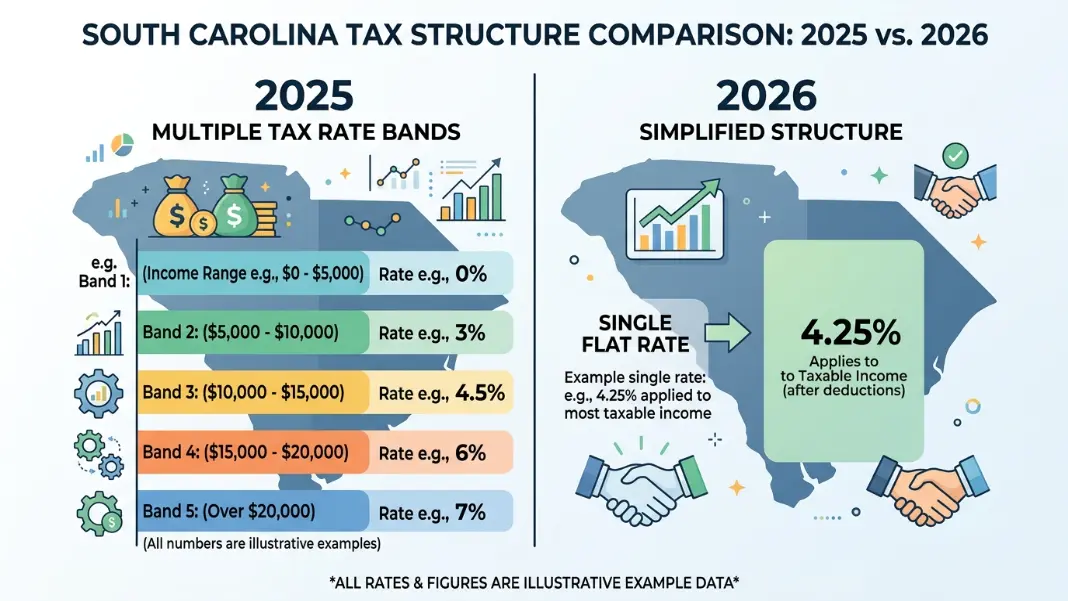
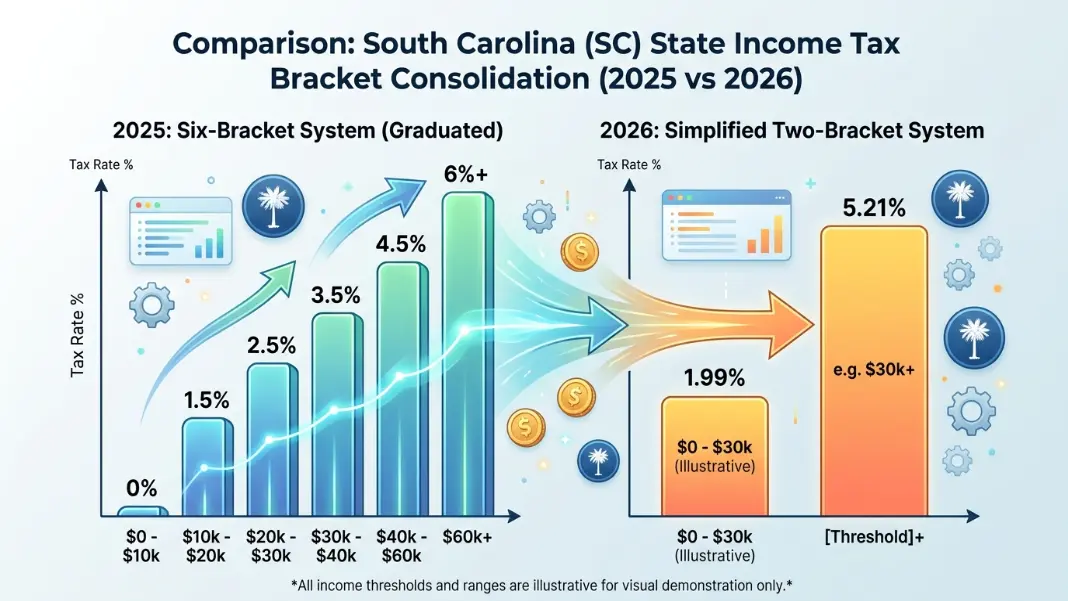
South Carolina has been quietly cutting its income tax since 2022, and 2026 completes the most significant structural change. The state's old six-bracket system with rates running from 0% to 7% is being replaced with a simplified two-bracket structure: 1.99% and 5.21% above the zero-rate floor. For most South Carolina workers, the 2026 reform means a lower effective state rate and a simpler withholding calculation.
The South Carolina Paycheck Calculator computes take-home pay using the current and updated rate structures. This guide explains the 2026 reform in concrete terms, covers which income is fully exempt from South Carolina tax, and shows take-home pay at three salary levels.
South Carolina's 2026 Rate Reform: What Changes and When#
South Carolina passed legislation phasing down its income tax rate from a 7% top bracket (as recently as 2021) toward a simplified flat-style structure. The progression:
- Pre-reform (through 2021): Six brackets, 0% to 7% top rate
- 2022 to 2025: Annual rate reductions, top rate stepping down from 7% to approximately 6.2% over the transition period
- 2026: Consolidation into the new structure: 0% on the first income tier, 1.99% on the second tier, and 5.21% on all income above the upper threshold
The 2026 structure replaces multiple narrow brackets with two meaningful rates. Income below the zero-rate floor remains untaxed. Income above the zero-rate floor but below the top bracket threshold pays 1.99%. Income at the top bracket pays 5.21%.
For an employee earning $75,000 in 2026:
Income in 0% bracket (first tier): $0 tax
Income in 1.99% bracket: applies to portion above zero-rate floor
Income above top bracket threshold: taxed at 5.21%
The specific dollar thresholds for the 2026 brackets are set by the South Carolina Department of Revenue and are indexed for inflation. The South Carolina Paycheck Calculator uses the confirmed 2026 thresholds once published.
Why this matters for withholding:
Under the old six-bracket system, the first $3,460 of taxable income was taxed at 0%, then 3%, 4%, 5%, 6%, and the top rate above $15,159. The narrow lower brackets meant the effective rate climbed quickly for middle-income workers. The 2026 simplification removes the 3%, 4%, 5%, and 6% brackets entirely and replaces them with a single 1.99% rate, which is meaningfully lower for incomes in the $15,000 to $40,000 taxable income range.
Military, Social Security, and Age 65 Exemptions: Who Pays Less#
South Carolina provides several income exemptions that reduce or eliminate state income tax for specific groups. Unlike most states, South Carolina makes military retirement pay completely exempt, not partially.
Military retirement income:
Military retirement pay is 100% exempt from South Carolina income tax with no income cap or age restriction. A retired Army colonel collecting $60,000 annually in military retirement benefits pays zero South Carolina state income tax on that income. This has applied since 2022 when South Carolina eliminated the previous partial deduction and went to full exemption.
Veterans receiving survivor benefit plan (SBP) payments also receive the exemption on the covered portion.
Social Security benefits:
Social Security retirement benefits are fully exempt from South Carolina income tax, regardless of income level. Combined with the military exemption, a retired service member receiving both Social Security and military pension pays no South Carolina income tax on either source.
Age 65 and older deduction:
Taxpayers who are 65 or older receive a deduction of up to $15,000 from South Carolina income (in addition to regular deductions). For a retired worker age 65 with $30,000 in taxable income from part-time work, this deduction could reduce South Carolina taxable income to $15,000 or eliminate it entirely depending on other deductions.
Other notable exemptions:
- Pension income from the South Carolina Retirement System (state government employees) receives favorable treatment
- Rental income from South Carolina agricultural land may qualify for exclusions under specific conditions
- Out-of-state income earned by South Carolina residents is generally subject to South Carolina tax, with credits for taxes paid to other states
For most W-2 workers under 65 without military retirement income, these exemptions do not apply. The take-home calculations below reflect the standard case.
Federal Withholding on a South Carolina Paycheck#
Federal income tax and FICA represent the majority of withholding for South Carolina employees, as in every state.
2025 federal income tax brackets for single filers:
| Taxable Income | Rate |
|---|---|
| Up to $11,925 | 10% |
| $11,926 to $48,475 | 12% |
| $48,476 to $103,350 | 22% |
| $103,351 to $197,300 | 24% |
| Over $197,300 | 32%+ |
FICA withholding on all W-2 wages:
- Social Security: 6.2% on wages up to $176,100 (2025 wage base)
- Medicare: 1.45% on all wages, plus 0.9% on wages over $200,000
Federal vs South Carolina at $75,000 (single, 2026 rates):
Federal income tax (approximate): $10,294
Social Security ($75,000 x 6.2%): $4,650
Medicare ($75,000 x 1.45%): $1,088
Total federal: $16,032

South Carolina state income tax (2026 structure, approximate): $2,400
Effective SC rate on $75,000: ~3.2%

Total withholding: $18,432
Take-home: $56,568
The effective South Carolina rate at $75,000 under the 2026 structure is materially lower than the 2025 rate at the same income (approximately 3.5% to 4% effective under the old six-bracket system). The consolidation removes the 5% and 6% brackets that applied to middle portions of income, replacing them with the lower 5.21% or 1.99% rates.
The Wisconsin Paycheck Tax Guide shows how another state with a 5.3% dominant bracket and a phasing standard deduction produces a different effective rate curve, particularly in the $50,000 to $110,000 range.
South Carolina Take-Home Pay at $50K, $75K, and $100K#
Three scenarios for a single South Carolina filer under the 2026 rate structure, no pre-tax deductions, standard W-4 settings, biweekly payroll:
| Gross Salary | Federal Tax | FICA | SC State Tax | Take-Home | Effective Total Rate |
|---|---|---|---|---|---|
| $50,000 | $5,294 | $3,825 | $1,390 | $39,491 | 21.0% |
| $75,000 | $10,294 | $5,738 | $2,400 | $56,568 | 24.6% |
| $100,000 | $16,244 | $7,650 | $3,650 | $72,456 | 27.5% |
South Carolina state tax figures above are estimated based on the 2026 simplified rate structure. Final figures will depend on the confirmed bracket thresholds once the South Carolina Department of Revenue publishes the 2026 withholding tables.
Pre-tax contributions reduce both federal and SC tax:
A $6,000 annual 401k contribution at the $75,000 level:
Federal tax savings (22% bracket): $1,320
South Carolina tax savings (5.21% top rate): $313
Total annual savings: $1,633
Net cost of $6,000 contribution: $4,367
South Carolina does not allow a deduction for 401k contributions that reduce federal income (these are the standard pre-tax 401k contributions through an employer). The state follows federal treatment of retirement contributions, meaning traditional 401k contributions that reduce federal AGI also reduce South Carolina taxable income.
South Carolina vs North Carolina, Georgia, and Florida#
South Carolina's 2026 reforms place it in a more competitive position relative to its neighbors.
| State | 2025 Structure | Top Rate | Effective Rate at $75K | Local Tax |
|---|---|---|---|---|
| South Carolina | 2 brackets + zero tier (2026) | 5.21% | ~3.2% (2026) | None |
| North Carolina | Flat rate, reducing | 4.25% (2025) | 4.25% | None |
| Georgia | Flat rate, reducing | 5.39% (2025) | 5.39% | None |
| Florida | No income tax | 0% | 0% | None |
| Virginia | Progressive | 5.75% top | ~5.0% | None |
| Tennessee | No wage income tax | 0% on wages | 0% | None |
Florida and Tennessee have no income tax on wages, making them zero-comparison baselines. For South Carolina workers who cannot or will not relocate to a no-tax state, the 2026 reform reduces the gap between SC and its lower-tax competitors.
North Carolina's flat rate of 4.25% (continuing to decrease under NC's own rate reduction schedule) will likely drop below South Carolina's effective rate at $75,000 by 2026. Georgia at 5.39% flat remains above South Carolina's effective rate at most income levels under the reformed structure.
The practical implication: South Carolina workers in the $50,000 to $100,000 range will see a lower effective state tax rate in 2026 than in any prior year. Workers near retirement age with military or Social Security income will already have been paying little to no South Carolina state income tax regardless of the reform.
For South Carolina workers who receive retirement income alongside wages, the Roth IRA Contribution Calculator shows how Roth vs traditional decisions interact with South Carolina's exemption structure. Roth contributions are made after tax, but withdrawals in retirement are untaxed, which stacks well with South Carolina's already favorable treatment of retirement income.
South Carolina's 2026 tax reform consolidates the previous six-bracket system into a simplified structure with a zero-rate tier, a 1.99% middle rate, and a 5.21% top rate. The 2026 reform replaces the prior brackets of 0%, 3%, 4%, 5%, 6%, and the old top rate that had been phasing down from 7% since 2022. For most single filers earning $50,000 to $100,000, the effective South Carolina rate under the 2026 structure is estimated at approximately 2.8% to 3.7%, meaningfully lower than under the old system.
No. Military retirement pay is fully exempt from South Carolina income tax with no income cap and no age restriction. This 100% exemption has been in effect since 2022, when South Carolina eliminated the prior partial deduction. Retired service members collecting military retirement income owe no South Carolina income tax on those benefits. Survivor benefit plan payments tied to military retirement also receive favorable treatment under the exemption.
Social Security retirement benefits are fully exempt from South Carolina income tax. There is no income threshold above which benefits become taxable at the state level, unlike the federal rule that taxes up to 85% of benefits for higher-income recipients. Combined with the military retirement exemption and the $15,000 age 65+ deduction, South Carolina retirees receiving Social Security and military pension typically pay no South Carolina income tax on those income sources.
No. South Carolina does not allow cities, counties, or municipalities to levy local income taxes. Every South Carolina resident pays the same state income tax rate regardless of whether they live in Columbia, Charleston, Greenville, Myrtle Beach, or a rural county. This is a meaningful advantage compared to states like North Carolina or Georgia, where some workers face county or city tax add-ons on top of state rates, though neither of those states currently has widespread local income taxes either.
Taxpayers who are 65 or older receive a deduction of up to $15,000 from South Carolina income in addition to standard deductions. This applies to any type of income, not just retirement income. A 65-year-old worker earning $25,000 from part-time employment could deduct $15,000, reducing South Carolina taxable income to $10,000 or less. Combined with the zero-rate bottom bracket and the Social Security exemption, many South Carolina retirees have effective state income tax rates of zero or very close to zero.
After the 2026 reform, South Carolina's top rate of 5.21% is above North Carolina's reduced flat rate of 4.25%. At $75,000 income, South Carolina's effective rate under the 2026 structure is approximately 3.2%, while North Carolina's flat rate of 4.25% applies to the full taxable income. South Carolina's zero-rate tier and lower 1.99% middle bracket keep the effective rate below the top rate and below NC's flat rate at middle incomes, despite the higher nominal top. Above roughly $60,000 to $70,000 in taxable income, North Carolina's flat rate may produce a lower state tax bill than South Carolina's 5.21% top bracket.
Written by
Hassaan Rasheed
Web Developer & Content Researcher
Hassaan builds calculators and writes source-linked guides across the site's subject areas. Calculator methods and reference data are documented in each guide so readers can verify the underlying sources.
About the author and methods