Maryland Paycheck Tax Guide: County Rates, New Bracket, and Take-Home Pay (2026)
Maryland paycheck tax: 4.75% to 6.5% state rates plus county income tax up to 3.30%. All 23 county rates and take-home pay at $60K to $120K.
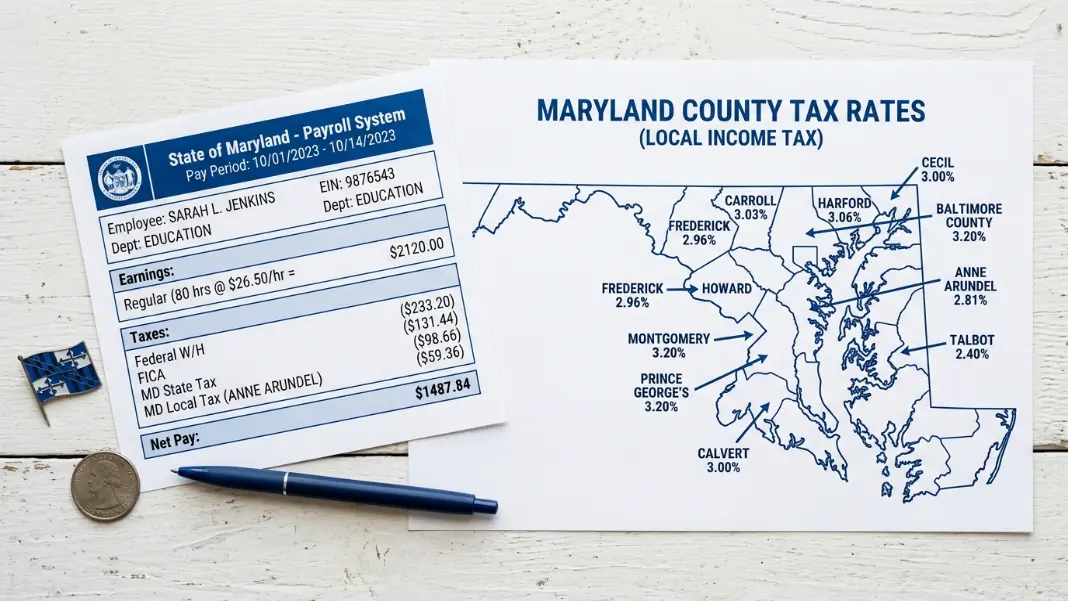
A Maryland paycheck has two state-level deductions, not one. The state income tax and the county income tax are both mandatory, both apply based on where you live, and both appear on the same withholding line in many payroll systems. New employees often see a deduction labeled "MD State + County" without realizing it packages two separate rates that can differ by more than one percentage point depending on which county they live in.
The Maryland Paycheck Calculator computes take-home for any salary, county, and filing status with the 2025 bracket structure built in. This guide covers the new top bracket, what every county charges, and how to read the combined withholding on your stub.
Maryland State Income Tax: Eight Brackets with a New Top Rate#
Maryland taxes income on a progressive schedule with eight brackets for single filers. For tax year 2025, a new 6.5% bracket applies to income above $250,000 for single filers and above $300,000 for married filing jointly. The previous top rate was 5.75%.
Maryland state income tax brackets for single filers (2025):
| Taxable Income | Rate |
|---|---|
| Up to $1,000 | 2% |
| $1,001 to $2,000 | 3% |
| $2,001 to $3,000 | 4% |
| $3,001 to $100,000 | 4.75% |
| $100,001 to $125,000 | 5% |
| $125,001 to $150,000 | 5.25% |
| $150,001 to $250,000 | 5.75% |
| Over $250,000 | 6.5% |
The lowest three brackets cover only $3,000 in income and produce $90 in combined tax. For a worker earning $80,000, those early brackets are a rounding error. The 4.75% rate does virtually all of the work.
Maryland state tax at $80,000 (single):
$0 to $1,000 at 2%: $20
$1,001 to $2,000 at 3%: $30
$2,001 to $3,000 at 4%: $40
$3,001 to $80,000 ($76,999 at 4.75%): $3,658
Total Maryland state tax: $3,748
Effective state rate: 4.69%
The lower brackets save the taxpayer exactly $90 compared to a flat 4.75% from dollar one. Maryland's approach to the first $3,000 is largely cosmetic.
Maryland state tax at $130,000 (single):
$0 to $3,000 (three low brackets): $90
$3,001 to $100,000 ($97,000 at 4.75%): $4,608
$100,001 to $125,000 ($25,000 at 5%): $1,250
$125,001 to $130,000 ($5,000 at 5.25%): $263
Total Maryland state tax: $6,211
Effective state rate: 4.78%
Income Maryland does not tax:
Social Security benefits are fully exempt from Maryland state income tax. Pension income from the federal government or Maryland state retirement systems receives a partial exclusion, up to $34,300 for taxpayers age 65 or older in 2025. Military retirement income is partially exempt at the same level.
Maryland County Income Tax: 23 Counties, All at Different Rates#
Every Maryland resident pays a county income tax on top of the state rate. The state collects it alongside state income tax and returns the revenue to the county. It applies to the same taxable income as the state calculation, uses the same W-4 or MW507 elections, and appears on most pay stubs as a single combined line with state income tax.
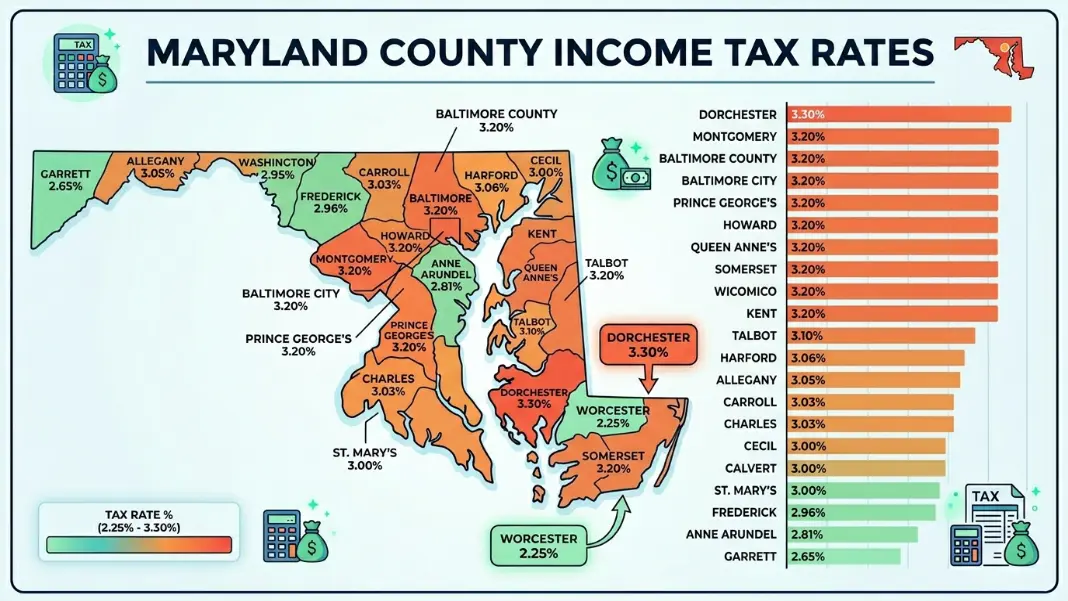
All 23 Maryland counties and Baltimore City levy a local income tax. Rates for 2025:
| Jurisdiction | Rate |
|---|---|
| Allegany | 3.05% |
| Anne Arundel | 2.81% |
| Baltimore City | 3.20% |
| Baltimore County | 2.83% |
| Calvert | 3.00% |
| Caroline | 3.20% |
| Carroll | 3.03% |
| Cecil | 3.00% |
| Charles | 3.03% |
| Dorchester | 3.30% |
| Frederick | 2.96% |
| Garrett | 2.65% |
| Harford | 3.06% |
| Howard | 3.20% |
| Kent | 3.20% |
| Montgomery | 3.20% |
| Prince George's | 3.20% |
| Queen Anne's | 3.20% |
| Somerset | 3.20% |
| St. Mary's | 3.00% |
| Talbot | 2.40% |
| Washington | 3.00% |
| Wicomico | 3.20% |
| Worcester | 2.25% |
Dorchester County at 3.30% charges the highest rate in the state. Worcester County at 2.25% and Talbot County at 2.40% are the lowest. For a worker earning $80,000, the difference between living in Dorchester versus Worcester is $840 per year, or about $32 per biweekly paycheck.
Anne Arundel and Frederick counties use slightly graduated local rate structures rather than a single flat rate. Anne Arundel applies 2.81% for most income levels, while Frederick uses a sliding calculation. Both ultimately produce effective county rates close to their published figures for income in the $50,000 to $200,000 range.
Which county rate applies:
The county where you live determines your county tax rate, not where you work. A Montgomery County resident commuting to Washington DC pays Montgomery's 3.20% rate. If you relocate to a lower-rate county, notify your employer and update your withholding form; the old county rate continues until the employer receives updated information.
Federal Withholding on a Maryland Paycheck#
Federal income tax and FICA take a larger share than state and county combined for most Maryland workers. Federal withholding uses the W-4 and the IRS graduated brackets.
2025 federal income tax brackets for single filers:
| Taxable Income | Rate |
|---|---|
| Up to $11,925 | 10% |
| $11,926 to $48,475 | 12% |
| $48,476 to $103,350 | 22% |
| $103,351 to $197,300 | 24% |
| Over $197,300 | 32%+ |
FICA applies to all W-2 wages:
- Social Security: 6.2% on wages up to $176,100 (2025 wage base)
- Medicare: 1.45% on all wages, plus 0.9% on wages over $200,000
Federal vs Maryland at $80,000 (single, Montgomery County):
Federal income tax (approximate): $10,294
Social Security ($80,000 x 6.2%): $4,960
Medicare ($80,000 x 1.45%): $1,160
Total federal: $16,414

Maryland state income tax: $3,748
Montgomery County tax ($80,000 x 3.20%): $2,560
Total state + county: $6,308

Total deductions: $22,722
Take-home: $57,278
Federal withholding accounts for 72% of the total tax in that scenario. The combined state and county share is 28%. Pre-tax elections change the picture: a $10,000 annual 401k contribution reduces federal taxable income at the 22% marginal rate ($2,200 savings) and Maryland taxable income at the combined state + county rate (approximately $800 savings), for a total of about $3,000 in annual tax savings.
The Ohio Paycheck Tax Guide covers a different structure where school district income tax layers onto state withholding in a way that parallels how Maryland's county tax works, but with more geographic variation.
Maryland Take-Home Pay at $60K, $80K, and $120K#
Three scenarios for a single filer in Montgomery County (3.20%), no pre-tax deductions, standard W-4 with no adjustments, biweekly payroll:
| Gross Salary | Federal Tax | FICA | MD State Tax | County Tax | Take-Home | Effective Rate |
|---|---|---|---|---|---|---|
| $60,000 | $6,294 | $4,590 | $2,748 | $1,920 | $44,448 | 25.9% |
| $80,000 | $10,294 | $6,120 | $3,748 | $2,560 | $57,278 | 28.4% |
| $120,000 | $19,094 | $9,180 | $6,211 | $3,840 | $81,675 | 31.9% |
County choice makes a real difference. The same $80,000 salary in Worcester County (2.25%) instead of Montgomery (3.20%):
Worcester County tax: $80,000 x 2.25% = $1,800
Montgomery County tax: $80,000 x 3.20% = $2,560
Annual difference: $760
Per biweekly paycheck: $29.23
Over a 30-year career at the same salary, that county rate difference compounds. Relocation within Maryland for a lower county rate rarely pencils out on its own, but for workers already considering a move for housing costs, the tax difference is worth factoring in.
Adding pre-tax deductions at $80,000 in Montgomery County:
401k contribution ($10,000/year pre-tax):
Reduced federal taxable income: saves ~$2,200 (22% marginal rate)
Reduced MD state + county tax: saves ~$640 (4.69% + 3.20% = 7.89%)
Total annual tax savings: ~$2,840
Net cost of $10,000 retirement contribution: $7,160
Health insurance premiums and FSA contributions reduce taxable income by the same mechanism. Most Maryland workers with access to these benefits leave money on the table by not fully understanding how each pre-tax dollar reduces both federal and combined state/county withholding.
Maryland vs Virginia, Pennsylvania, and DC#
Maryland's neighboring states each use different local tax structures, which changes the comparison significantly depending on where a worker lives relative to their job.
| Jurisdiction | Effective State Rate at $80K | Local Tax | Combined State + Local |
|---|---|---|---|
| Maryland | 4.69% | 2.25% to 3.30% | 6.94% to 7.99% |
| Virginia | ~5.0% | None statewide | ~5.0% |
| Pennsylvania | 3.07% (flat) | 1.0% to 3.80% (city-based) | 4.07% to 6.87% |
| DC | ~6.0% | None (DC is the jurisdiction) | ~6.0% |
| Delaware | ~4.8% | None | ~4.8% |
| West Virginia | ~4.5% effective | None | ~4.5% |
Virginia does not allow localities to impose income taxes; its state-only rate of 5.75% top (5.0% effective at $80,000) is the full picture. For residents near the Maryland-Virginia border in Montgomery or Prince George's counties, the combined MD state + county rate is typically 2 to 3 percentage points higher than Virginia's rate at the same income.
Pennsylvania has no local income tax at the county level, but cities like Philadelphia add a 3.44% wage tax on residents. A Pennsylvania worker outside Philadelphia pays only the state's 3.07% flat rate, which is lower than Maryland's state-only rate.
For Maryland workers planning for retirement, the Roth IRA Contribution Calculator shows your 2026 maximum contribution based on MAGI. Single filers above $150,000 begin to see Roth eligibility phase out, a threshold that is relevant for Maryland professionals in government contracting, healthcare, and finance around the DC corridor.
Maryland income tax uses eight brackets from 2% to 6.5% for single filers. At $80,000, the effective state rate is approximately 4.69%, producing about $3,748 in annual state tax. The 4.75% bracket covers most wages between $3,001 and $100,000. A separate county income tax applies on top of the state rate, adding 2.25% to 3.30% depending on where you live. The Maryland Paycheck Calculator shows exact per-paycheck withholding for any salary and county combination.
Every Maryland resident pays a county income tax in addition to state income tax. Rates range from 2.25% in Worcester County to 3.30% in Dorchester County. Baltimore City, which functions as a county, charges 3.20%. The tax is based on where you live, not where you work, and is withheld alongside state income tax, often appearing as a single combined line on pay stubs. You must update your Maryland withholding form with your employer if you move to a different county.
Worcester County has the lowest local income tax rate in Maryland at 2.25%, followed by Talbot County at 2.40% and Garrett County at 2.65%. The highest county rates are Dorchester at 3.30% and a cluster of jurisdictions including Baltimore City, Howard, Montgomery, Prince George's, and several others at 3.20%. The spread between the highest and lowest county rates is just over 1 percentage point, which amounts to about $840 per year at an $80,000 salary.
Maryland added a 6.5% state income tax bracket for tax year 2025, applying to income above $250,000 for single filers and above $300,000 for married filing jointly. The previous top rate was 5.75%. For a single filer earning $280,000, the 6.5% rate applies to $30,000 of income (the amount above $250,000), adding $225 in additional state tax compared to the prior top bracket. Combined with the county rate, Maryland's effective top combined rate exceeds 9.5% for high earners in the higher-rate counties.
Maryland does not use a city income tax structure. Instead, county income taxes apply to all residents based on their county of residence. Baltimore City functions as its own county equivalent and levies a 3.20% local rate. No city or municipality within a county adds an additional income tax layer on top of the county rate. This differs from Pennsylvania, where cities like Philadelphia impose a separate wage tax above and beyond the state rate.
Maryland's combined state and county rate is typically higher than Virginia's state-only rate. At $80,000 single, Maryland state tax runs about 4.69%, plus county tax of 2.25% to 3.30%, for a combined 6.94% to 7.99%. Virginia's top state rate is 5.75%, with no local income tax, putting effective Virginia rates around 5.0% at that income level. For residents weighing a move across the state line, the Maryland-Virginia difference is roughly 2 to 3 percentage points in combined state and local tax depending on which Maryland county is involved.
Written by
Hassaan Rasheed
Web Developer & Content Researcher
Hassaan builds calculators and writes source-linked guides across the site's subject areas. Calculator methods and reference data are documented in each guide so readers can verify the underlying sources.
About the author and methods