How to Calculate Your Period Cycle Length and Predict Future Dates (2026)
Learn how to calculate your menstrual cycle length, when a period is late vs missed, and what affects period calculator accuracy. Includes manual formula.
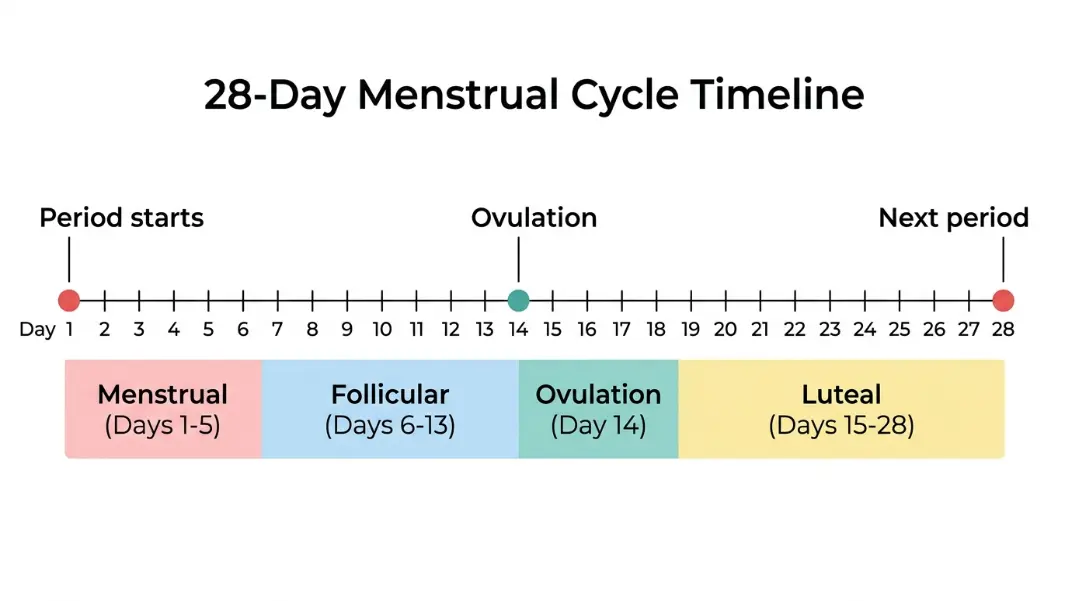
Most period tracking apps and calculators ask for two numbers: the date your last period started and your cycle length. The second number, cycle length, is the one most people enter incorrectly, or simply leave at the default 28 days without checking whether that matches their actual biology. Getting this number right is what separates a useful prediction from one that is consistently off by several days.
This guide covers how to calculate your cycle length manually, what counts as a late period versus a missed one, and what affects period calculator accuracy. To get your predicted dates, use the Period Calculator. The sections here explain what makes those predictions reliable or not.
How to Calculate Your Menstrual Cycle Length#
Cycle length is counted from the first day of one period to the first day of the next, not the last day of bleeding. This is the most common counting error. If your period started on April 2 and your next period started on April 30, your cycle is 28 days (April 2 to April 30), even if April 2's period lasted 5 days.
The formula:
Cycle length = Day your next period started - Day your last period started
Step-by-step example:
- Last period started: March 8
- Current period started: April 5
- Cycle length: April 5 - March 8 = 28 days
For months with different lengths, count the actual days. From March 8 to April 5: 23 days remaining in March (31 - 8 = 23) plus 5 days in April = 28 days.
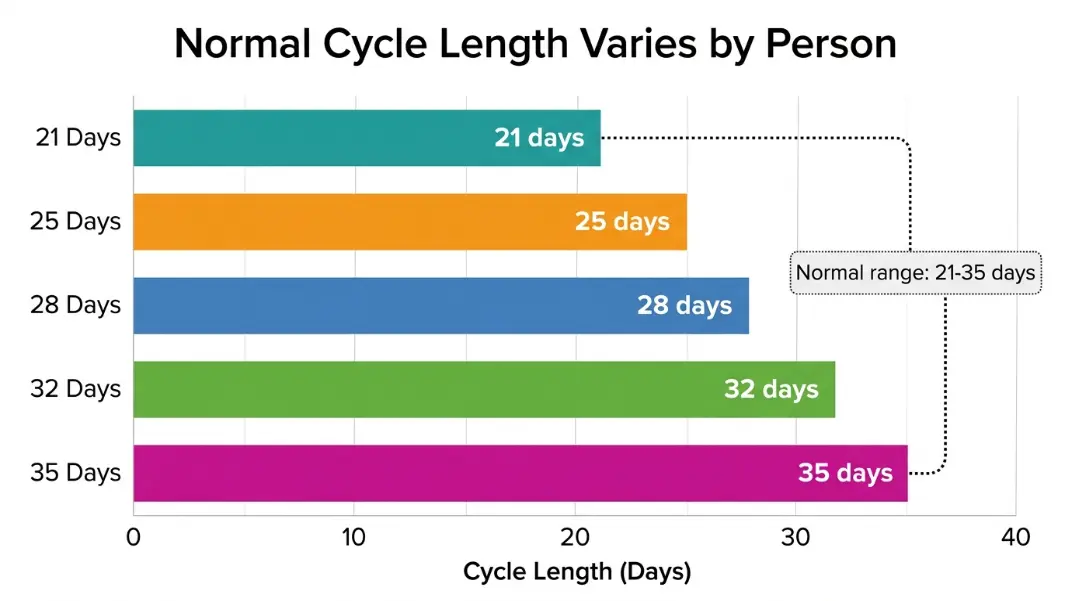
What is a normal cycle length?
Normal menstrual cycles range from 21 to 35 days. The 28-day average is accurate for the population mean but is not a standard any individual cycle should be measured against. Research published in the journal NPJ Digital Medicine (2019), which analyzed over 600,000 menstrual cycles, found that only 13% of cycles were exactly 28 days. The most common range in that dataset was 25-30 days.
| Cycle Length | Category |
|---|---|
| Under 21 days | Polymenorrhea (frequent periods). Discuss with a doctor. |
| 21-24 days | Short but within normal range for many people |
| 25-35 days | Standard normal range |
| 36-45 days | Oligomenorrhea (infrequent periods), worth monitoring |
| Over 45 days | Discuss with a doctor |
For the most accurate prediction, calculate your average cycle length using at least 3 months of data. Add each cycle length and divide by the number of cycles. A person with cycles of 26, 29, and 27 days has an average of (26 + 29 + 27) / 3 = 27.3 days. Enter 27 into the period calculator.
Is My Period Late? How to Use a Late Period Calculator#
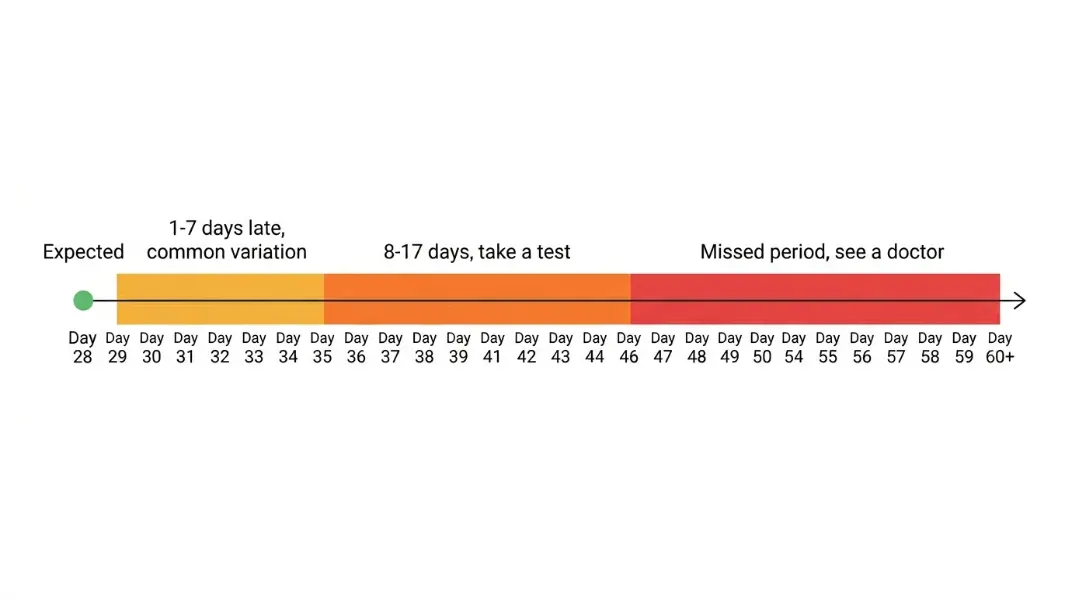
A period is not late until it has passed your expected start date. If your average cycle is 28 days and you are on Day 29 with no period, it is 1 day late, not missed. Cycle length naturally varies even in people with regular cycles.
How much day-to-day variation is normal depends on your own history. A 2006 study published in Human Reproduction found that even women with regular cycles have a standard deviation of 2-3 days. This means a period arriving 3 days later than expected is normal variation, not a delay.
General framework for interpreting late periods:
- 1-4 days late: Normal variation. No action needed unless this is unusual for you personally.
- 5-7 days late: Still common but worth noting. Stress, travel, illness, or changes in sleep can delay ovulation, which pushes the period date back.
- 8-17 days late: The period is noticeably delayed. A home pregnancy test (accurate from the day your period was due) is a reasonable next step if pregnancy is possible.
- 18-30 days late: A delayed period of this length warrants a test and potentially a conversation with a doctor, especially if pregnancy tests are negative.
- 30+ days late: This typically means one cycle has been skipped. This is considered a missed period rather than a late one.
The key number to know is your own typical variation, not a generic standard. Someone whose cycle has varied by 2 days for years should pay attention at Day 5 late. Someone with a naturally variable cycle might not notice until Day 10.
Missed Period vs Late Period: What's the Difference?#
A late period is one that has not arrived at the predicted time but is expected to arrive within the current cycle window. A missed period means the cycle has ended without a period starting, and a new cycle has technically begun.
In practical terms: if your average cycle is 28 days and you are on Day 45 with no bleeding, you have missed a period. Your next cycle should have started over a week ago.
Common causes of a single missed period that are not pregnancy include:
- High physical or psychological stress: Stress activates the hypothalamic-pituitary-adrenal axis, which can suppress GnRH (gonadotropin-releasing hormone) and delay or prevent ovulation.
- Significant weight change: Both rapid gain and loss affect estrogen production. Weight loss below a body fat percentage threshold (roughly 17-22% for most people) can stop ovulation entirely.
- Thyroid dysfunction: Both hypothyroidism and hyperthyroidism disrupt the hormonal cascade that regulates the menstrual cycle.
- Polycystic ovary syndrome (PCOS): PCOS causes irregular or absent ovulation, leading to unpredictable or absent periods. Insulin resistance, which can be tracked through HbA1c levels, is a common underlying factor. For context on how blood glucose relates to hormonal health, see the A1C Calculator.
- Perimenopause: From the late 30s onward, cycle length and regularity naturally become more variable. Missed periods in this age group are often the first sign of perimenopause rather than a pathological condition. The Chronological Age Calculator can help you calculate your exact age in years and months if you are assessing where you fall in reproductive timelines.
- Medications: Certain medications including antipsychotics, some antidepressants, and hormonal contraceptives starting or stopping can disrupt cycle timing.
Two or more consecutive missed periods without a clear cause (pregnancy, menopause, medication) warrant evaluation by a doctor.
What Affects Period Calculator Accuracy#
Period calculators work by adding your average cycle length to the date your last period started. The accuracy of that prediction depends entirely on how consistent your cycles are. The calculator cannot know what your body will do in any given cycle.
Factors that reduce accuracy:
Cycle length variability. If your last 6 cycles were 26, 31, 28, 24, 30, and 27 days, the average is 27.7 days but the actual variation is up to 7 days. A calculator using the average will be within that range of error on any given month. This is not a calculator error. It reflects real biological variability.
Ovulation timing shifts. Most calculators assume ovulation occurs 14 days before the next period (the luteal phase length). But luteal phase length varies from person to person and can range from 9 to 16 days. Someone with an 11-day luteal phase has later ovulation relative to their period than someone with a 14-day phase. Ovulation predictor kits (OPKs) measure this directly rather than estimating it.
Stress and illness. Both can delay ovulation, which extends the follicular phase and pushes the period back by the same number of days. A fever during the middle of a cycle can delay ovulation by 2-5 days, shifting the predicted period date accordingly.
Recent hormonal contraceptive use. Coming off hormonal birth control often produces irregular cycles for 3-6 months. Predictions during this phase are less reliable because the cycle has not re-established a baseline length.
Postpartum and breastfeeding. The return of the menstrual cycle after birth varies widely and is further suppressed by breastfeeding (lactational amenorrhea). Period calculators should not be used during this phase until at least 2-3 regular cycles have been established.
Improving accuracy over time:
The more months of data you log, the more accurate your predictions become. A calculator working from 1 month of data is essentially guessing using your last cycle as the estimate. One working from 6 months of consistent data can narrow the prediction window significantly. Logging bleeding start dates consistently (even just in a notes app) is the most reliable way to improve prediction accuracy.
How to Calculate Your Period Cycle for Planning and Health Tracking#
Beyond predicting the next period date, cycle length data is useful for:
Identifying trends. If your cycles were consistently 27-28 days for years and have shifted to 32-34 days without a clear cause, that change is worth noting. Gradual cycle lengthening can indicate hormonal shifts, thyroid changes, or the beginning of perimenopause.
Identifying fertile windows for family planning. Ovulation typically occurs approximately 14 days before the next expected period (not 14 days after the last period unless your cycle is exactly 28 days). For a 32-day cycle, ovulation likely occurs around day 18. For a 24-day cycle, around day 10. The Period Calculator shows both predicted period dates and estimated fertile windows.
Recognizing patterns before appointments. Bringing 3-6 months of cycle start dates to a gynecology appointment gives the provider more useful data than a verbal description of "irregular periods." Exact dates let them calculate cycle lengths, spot patterns, and decide whether any testing is needed.
Tracking changes after starting or stopping medications. Any hormonal intervention will affect cycle timing. Logging before and after gives you data to discuss with your prescriber.
Count from the first day of one period to the first day of the next. Do not count from the last day of bleeding. If your period started March 8 and the next one started April 5, your cycle is 28 days. For the most accurate average, track 3-6 cycles and calculate the mean: add all cycle lengths and divide by the number of cycles recorded.
A period is considered missed when the cycle has ended without bleeding and a new cycle window has begun. In practice, most clinicians use 6 or more weeks since the last period as the threshold for a missed period. A period that is 1-7 days late is common variation. A period that is 8-17 days late warrants a pregnancy test. A period that is 30 or more days late typically means one cycle has been skipped.
Period calculators are as accurate as the data entered and as consistent as the person's own cycle. For someone with cycles consistently between 27 and 29 days, predictions will usually land within 2-3 days. For someone whose cycles vary between 24 and 35 days, the prediction error window is much wider. No calculator can account for cycle-to-cycle hormonal variation, illness, stress, or ovulation timing shifts in real time.
Normal cycle length ranges from 21 to 35 days. The 28-day cycle is the population average but describes only about 13% of actual cycles in large datasets. Short cycles (21-24 days) and longer cycles (30-35 days) are both normal. Cycles consistently outside the 21-35 day range, or cycles that vary by more than 7-9 days each month, are worth discussing with a doctor.
Yes. Psychological and physical stress can delay ovulation by activating the HPA axis and suppressing GnRH release. This extends the follicular phase (pre-ovulation) and pushes the period back by however many days ovulation was delayed. A period that arrives 5-7 days late during a period of high stress or illness is a common and normal response. The period should return to its regular schedule the following cycle once the stressor is resolved.
Average at least 3 cycles: add the length of each cycle and divide by the number of cycles. For cycles of 26, 31, and 28 days: (26 + 31 + 28) / 3 = 28.3 days, so enter 28. The prediction will reflect the middle of your range rather than an exact date. For cycles that vary by more than 10 days consistently, period prediction accuracy is inherently limited and a broader fertile window and period range is more useful than a single predicted date.
Written by
Hassaan Rasheed
Web Developer & Content Researcher
Hassaan builds calculators and writes source-linked guides across the site's subject areas. Calculator methods and reference data are documented in each guide so readers can verify the underlying sources.
About the author and methods