Wisconsin, South Carolina, Mississippi, and Connecticut Paycheck Tax Guide (2025-26)
Wisconsin paycheck calculator guide: SC flat tax path, Mississippi's $10K zero-rate band, and Connecticut's bracket structure. Take-home pay 2025-26.
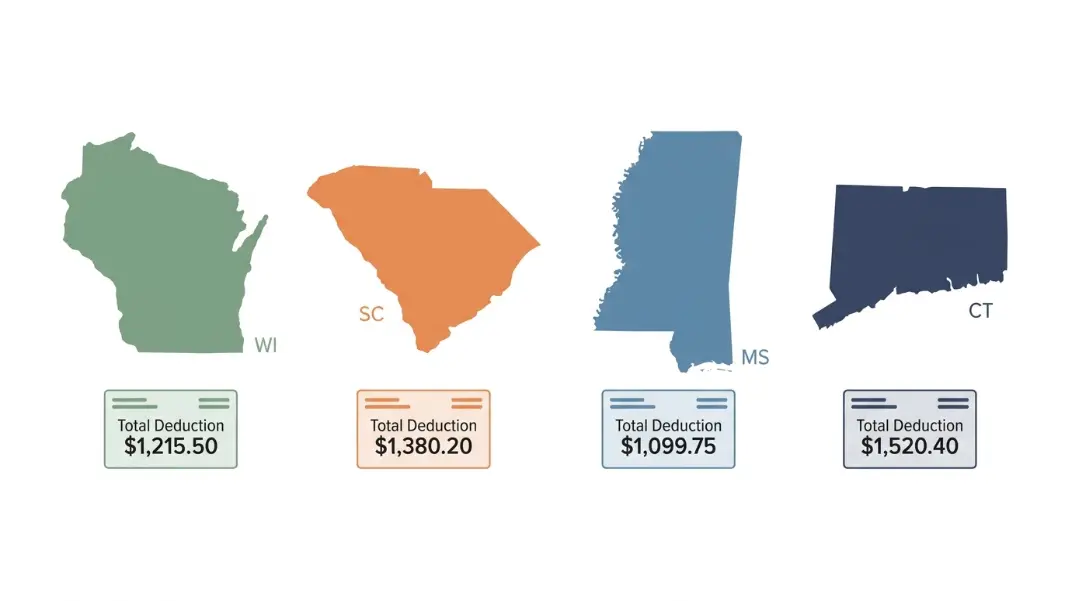
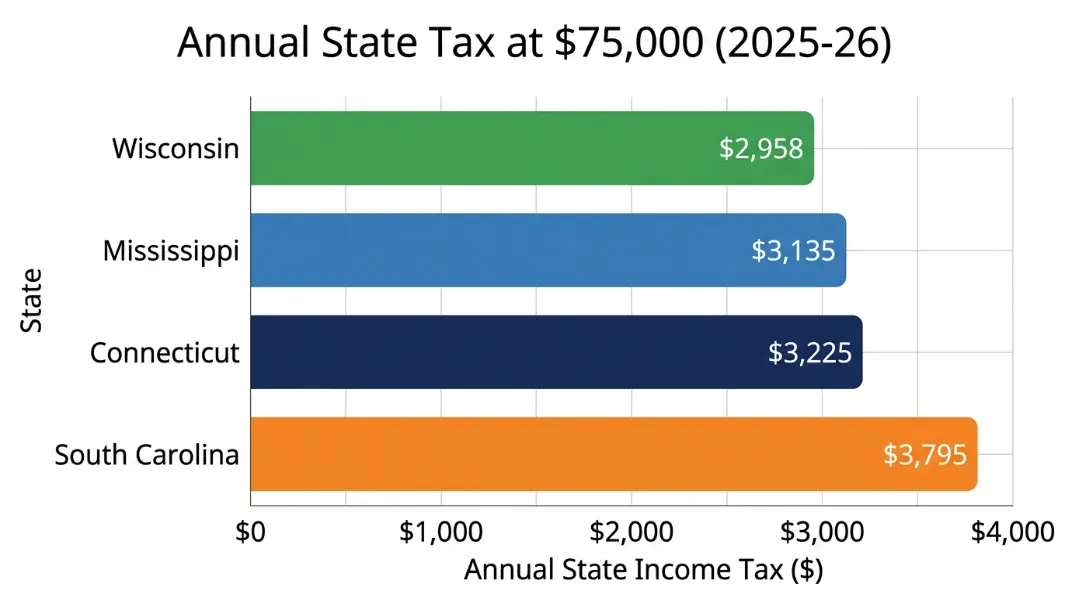
For middle-income workers at $75,000, Wisconsin produces better take-home pay than South Carolina, despite Wisconsin having four tax brackets and South Carolina actively cutting its top rate every year. The reason is Wisconsin's $11,880 standard deduction, which shelters more income before any bracket applies than South Carolina's structure allows. Headline rates tell an incomplete story.
The Wisconsin Paycheck Calculator runs the exact withholding numbers for Wisconsin residents. This guide covers how each of these four states taxes wages differently: Wisconsin's bracket structure with its large deduction, South Carolina's multi-year rate-cutting path, Mississippi's recently reformed zero-rate band, and Connecticut's high top rate with a lower effective rate for most workers.
How Wisconsin Taxes Your Paycheck: Four Brackets and a Large Standard Deduction
Wisconsin uses four income tax brackets applied after a standard deduction that reduces taxable income significantly before any rate applies.
Wisconsin 2025 tax brackets (single filer):
| Taxable Income | Rate |
|---|---|
| $0 to $14,320 | 3.50% |
| $14,321 to $28,640 | 4.40% |
| $28,641 to $314,150 | 5.30% |
| Over $314,150 | 7.65% |
The standard deduction for a single filer in Wisconsin is approximately $11,880 in 2025. That means a worker earning $60,000 has taxable income of $48,120 before bracket rates apply.
Wisconsin withholding at $75,000 gross salary (single):
- Taxable income: $75,000 - $11,880 = $63,120
- First $14,320 at 3.50%: $501
- Next $14,320 at 4.40%: $630
- Remaining $34,480 at 5.30%: $1,827
- Total state tax: $2,958/year ($247/month)
- Effective rate on gross: 3.94%
Wisconsin has no local income taxes. Workers in Milwaukee, Madison, and Green Bay all pay only the state rate plus federal. That is one of the genuine advantages for Wisconsin workers compared to Ohio (SDIT local tax applies in many municipalities) and other large Midwest states.
The top 7.65% bracket kicks in above $314,150 for single filers. At that rate, Wisconsin is competitive with its neighbors but noticeably below Minnesota, which reaches 9.85% on high earners.
Wisconsin also does not charge a separate SUI contribution on employee wages. Unemployment tax is an employer-only cost.
South Carolina's Rate-Cutting Path: Lower Every Year Until 2027
South Carolina has been systematically reducing its top income tax rate since 2022 under the South Carolina Taxpayer Relief Act. The rate was 7.0% in 2021. It has dropped each year and is on track to reach 6.0% by 2027, dropping by 0.1% annually as long as state revenues meet the trigger threshold.
South Carolina 2025 tax structure (single filer):
| Taxable Income | Rate |
|---|---|
| $0 to $3,460 | 3.0% |
| Over $3,460 | 6.2% |
South Carolina has simplified its bracket structure significantly. Most taxable income above the small 3% band is taxed at the top rate of 6.2% in 2025. There is no large standard deduction to shelter income the way Wisconsin provides: South Carolina's standard deduction is $12,000 for single filers (federal conforming), and the first $3,460 is taxed at only 3%.
South Carolina withholding at $75,000 gross salary (single):
- Taxable income: $75,000 - $12,000 = $63,000
- First $3,460 at 3.0%: $104
- Remaining $59,540 at 6.2%: $3,691
- Total state tax: $3,795/year ($316/month)
- Effective rate on gross: 5.06%
South Carolina's 6.2% top rate is higher than Wisconsin's effective rate structure for middle incomes, which is why workers at $75,000 pay more state tax in South Carolina than in Wisconsin even after all the rate cuts. South Carolina has no local income tax at the city or county level, which keeps its total state-level burden simple to calculate.
By 2027 when the top rate reaches 6.0%, the $75,000 South Carolina tax bill will fall to approximately $3,672, still above the Wisconsin figure.
The South Carolina Paycheck Calculator applies the current 2025 rate and will update as cuts continue.
Mississippi's $10,000 Zero-Rate Band: How the State's Tax Reform Works
Mississippi passed one of the most significant state income tax reforms in the country in 2022. The Mississippi Taxpayer Pay Act eliminated income tax on the first $10,000 of taxable income, reducing the effective burden substantially for middle-wage workers.
Mississippi 2025 tax structure (after standard deduction):
| Taxable Income | Rate |
|---|---|
| $0 to $10,000 | 0% |
| Over $10,000 | 5.0% |
Mississippi's standard deduction is $2,300 for single filers and $4,600 for married filers.
Mississippi withholding at $75,000 gross salary (single):
- Taxable income: $75,000 - $2,300 = $72,700
- First $10,000 at 0%: $0
- Remaining $62,700 at 5.0%: $3,135
- Total state tax: $3,135/year ($261/month)
- Effective rate on gross: 4.18%
The zero-rate band is what makes Mississippi's structure work well for lower and middle incomes. A worker earning $35,000 in Mississippi pays 5% on only $22,700 (after the $2,300 deduction and $10,000 zero band): $1,135/year. The same worker in South Carolina would pay roughly $1,421/year.
Mississippi is also working toward further reductions. The 5.0% top rate is scheduled to continue declining by 0.5% increments through 2030, targeting an eventual elimination of the income tax on earned wages entirely, contingent on revenue triggers being met.
Mississippi has no local income tax. The calculation is straightforward: one rate on one band above the zero threshold.
Connecticut Paycheck Tax: Top Rate 6.99%, Effective Rate Much Lower for Most Workers
Connecticut has the most complex structure of these four states, with seven income tax brackets and a personal exemption credit that reduces liability significantly for workers under $200,000.
Connecticut 2025 tax brackets (single filer):
| Taxable Income | Rate |
|---|---|
| $0 to $10,000 | 2.0% |
| $10,001 to $50,000 | 4.5% |
| $50,001 to $100,000 | 5.5% |
| $100,001 to $200,000 | 6.0% |
| $200,001 to $250,000 | 6.5% |
| $250,001 to $500,000 | 6.9% |
| Over $500,000 | 6.99% |
The top rate of 6.99% gets the headlines. But for a single worker at $75,000, the rate structure produces a much lower effective rate:
Connecticut withholding at $75,000 gross salary (single):
- $10,000 at 2.0%: $200
- $40,000 at 4.5%: $1,800
- $25,000 at 5.5%: $1,375
- Total state tax before credits: $3,375/year
- Personal exemption credit (phased at higher incomes, available here): approximately $150
- Net state tax: $3,225/year ($269/month)
- Effective rate on gross: 4.30%
Connecticut also has a "bubble" provision where high earners above certain thresholds face a recapture calculation that effectively increases their marginal rate. This applies above $200,000 for single filers and does not affect most payroll calculations.
Connecticut does not have a local income tax applicable to most workers. A few municipalities have emergency service district taxes, but these are not general income taxes on wages.
The 6.99% top rate is real for Connecticut's highest earners. For workers at $55,000-$100,000, the seven-bracket structure produces effective rates between 3.8-4.8%, which is competitive with many states that quote lower headline rates.
Use the Connecticut Paycheck Calculator for exact withholding with filing status and exemptions factored in.
Take-Home Pay at $55,000 and $85,000: All Four States Compared
These figures use 2025-26 rates, single filing status, standard deductions for each state, and no pre-tax retirement contributions. Federal income tax and FICA (7.65%) are the same across all four states and are excluded from the state-level comparison.
Annual state income tax at $55,000 gross salary:
| State | Annual State Tax | Effective State Rate | Monthly Tax |
|---|---|---|---|
| Wisconsin | $1,898 | 3.45% | $158 |
| Mississippi | $2,135 | 3.88% | $178 |
| Connecticut | $2,275 | 4.14% | $190 |
| South Carolina | $2,636 | 4.79% | $220 |
Annual state income tax at $85,000 gross salary:
| State | Annual State Tax | Effective State Rate | Monthly Tax |
|---|---|---|---|
| Wisconsin | $3,488 | 4.10% | $291 |
| Mississippi | $3,635 | 4.28% | $303 |
| Connecticut | $3,925 | 4.62% | $327 |
| South Carolina | $4,464 | 5.25% | $372 |
Three patterns stand out across both income levels:
Wisconsin leads at both salary points because the $11,880 standard deduction shelters a larger share of gross income before brackets apply. The 5.30% bracket rate is not low, but it applies to a smaller base.
Mississippi punches above its weight for lower-income workers because the $10,000 zero-rate band eliminates tax on the first significant chunk of taxable income. The single 5.0% rate above that band is higher than Wisconsin's lower brackets, but the zero band creates a meaningful offset for workers under $60,000.
South Carolina is the most expensive of the four at every income level, even after several years of rate cuts. The 6.2% top rate applies to nearly all taxable income above $3,460, and the standard deduction does not shelter income the way Wisconsin's does. By 2027, when SC's top rate reaches 6.0%, the $85,000 tax bill drops to approximately $4,304, which still exceeds Wisconsin's figure.
Connecticut's real-world effective rates are closer to Wisconsin's than the top-rate headline suggests. Workers often look at CT's 6.99% and assume it is more expensive than Wisconsin's 5.30% top bracket. At $85,000, Connecticut costs $437 more per year than Wisconsin, not thousands more. That difference narrows further once Connecticut's personal exemption credit is applied.
For the Mississippi Paycheck Calculator, exact monthly withholding depends on your employer's withholding elections and any additional allowances. The zero-rate band is built into the state's withholding tables automatically.
Wisconsin withholds state income tax at four bracket rates from 3.50% to 7.65%, applied after a standard deduction of approximately $11,880 for single filers. At $75,000 gross salary, a single Wisconsin worker pays about $2,958 in state income tax per year, or $247 per month. That is an effective state rate of 3.94% of gross wages. Wisconsin has no local income tax in most areas, and no employee unemployment tax contribution.
South Carolina taxes most wage income at 6.2% in 2025, after the first $3,460 of taxable income which is taxed at 3.0%. South Carolina has been cutting its top rate annually since 2022 and targets a 6.0% top rate by 2027. At $60,000 gross with a $12,000 standard deduction, the annual state tax is approximately $2,906. There is no local income tax in South Carolina.
Mississippi taxes the first $10,000 of taxable income at 0% and all income above that at 5.0%. After subtracting the $2,300 standard deduction for single filers, a worker earning $50,000 pays 5% on only $37,700, not on the full income. This zero-rate band significantly reduces the effective tax rate for lower and middle-income workers. Mississippi is also gradually reducing the 5.0% rate toward zero through 2030.
Connecticut's 6.99% top rate applies only to income above $500,000. Most workers pay lower bracket rates: 2% on the first $10,000, 4.5% on the next $40,000, and 5.5% on income between $50,001 and $100,000. A single filer earning $75,000 in Connecticut pays about $3,225 in state tax, an effective rate of 4.3%. The progressive bracket structure means the top rate affects a very small share of total income for most workers.
Wisconsin has the lowest effective state income tax rate for most middle-income workers, primarily because of its $11,880 standard deduction which reduces taxable income before bracket rates apply. At both $55,000 and $85,000 gross salary, Wisconsin produces the lowest annual state income tax of the four states. Mississippi is a close second for workers under $60,000 because of its $10,000 zero-rate band, but Mississippi's flat 5.0% rate on higher income closes the gap.
None of these four states have widespread local income taxes on wages. Wisconsin, South Carolina, Mississippi, and Connecticut all levy income tax only at the state level for the vast majority of workers. This contrasts with states like Ohio (where many municipalities levy a separate SDIT tax), Pennsylvania (where every municipality charges local earned income tax), and Maryland (where every county charges a mandatory piggyback tax on top of state tax).
Written by
Hassaan Rasheed
Web Developer & Content Researcher
Hassaan builds calculators and writes research-backed guides on finance, math, payroll, and construction topics. Every number in his articles is sourced from official data and worked through by hand.
View LinkedIn Profile