New York, New Jersey, Indiana, and Michigan Paycheck Tax Guide (2025)
NY paycheck calculator guide: NJ graduated rates, Indiana county taxes, Michigan city taxes, and NYC city tax. Take-home pay at $55K and $85K.
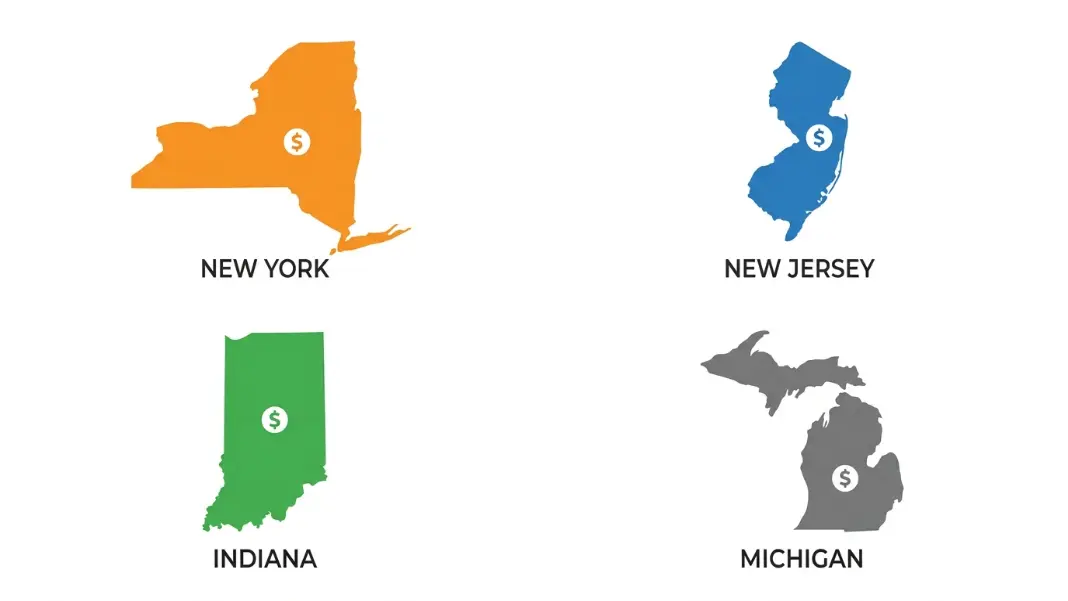
New Jersey's income tax rate climbs to 10.75% at the top end, higher than New York's 9.65%. But a New Jersey worker earning $55,000 pays $1,492 in state income tax for the year. An Indiana worker at the same salary pays $1,647 under Indiana's flat 3.05% rate. New Jersey's graduated brackets start at 1.4%, which pulls the effective rate for middle earners well below Indiana's flat rate. If you've been told New Jersey is one of the expensive states, the paycheck math is more nuanced than the top rate suggests.
These four states use four different systems. New York uses a multi-bracket structure that stays moderate through about $160,000, then steps up sharply for high earners. New Jersey has a similar graduated structure but with much lower entry rates. Indiana and Michigan both use flat state rates, but both stack county or city income taxes on top that can add anywhere from 1% to 2.4% depending on where you live. The New York Paycheck Calculator handles the full computation for New York workers, including New York City's separate city tax layer. This guide breaks down how each state's system works and what you actually take home.
How New York State Taxes Your Paycheck#
New York's state income tax uses 9 brackets starting at 4% and reaching 9.65% above $2.155 million. For most full-time employees, the relevant range is the 5.85% bracket, which covers all taxable income between $27,901 and $161,550.
New York state income tax brackets (2025, single filer):
| Taxable Income | Rate |
|---|---|
| Up to $17,150 | 4.00% |
| $17,151 to $23,600 | 4.50% |
| $23,601 to $27,900 | 5.25% |
| $27,901 to $161,550 | 5.85% |
| $161,551 to $323,200 | 6.25% |
| $323,201 to $2,155,350 | 6.85% |
| Over $2,155,350 | 9.65%+ |
The New York standard deduction for a single filer is $8,000, applied before brackets.
How the state tax works at $55,000 gross salary:
- Taxable income: $55,000 - $8,000 = $47,000
- Tax on first $17,150 at 4.00%: $686
- Tax on next $6,450 at 4.50%: $290
- Tax on next $4,300 at 5.25%: $226
- Tax on remaining $19,100 at 5.85%: $1,118
- New York state tax: approximately $2,320 (effective state rate: 4.22%)
New York does not have a county income tax outside of New York City and Yonkers. Workers in Buffalo, Rochester, Albany, Syracuse, or anywhere on Long Island pay only the state brackets above. NYC residents pay an additional city income tax on top of this, which is covered in its own section below.
At $85,000 gross salary ($77,000 taxable):
- Tax from the $27,901 bracket formula: $1,202 + 5.85% × ($77,000 - $27,900) = $1,202 + $2,872
- New York state tax: approximately $4,074 (effective state rate: 4.79%)
The effective state rate rises from 4.22% at $55,000 to 4.79% at $85,000, reflecting the front-loaded bracket structure. Most of the income falls into the 5.85% bracket in both cases.
New Jersey's Rate Structure: Why Middle Earners Pay Less Than the Top Rate Suggests#
New Jersey's income tax has a feature that most comparisons overlook: the first $20,000 of taxable income is taxed at just 1.4%, and the next $15,000 at 1.75%. These two bottom brackets cover the first $35,000 of income at rates far below Indiana's flat 3.05%.
New Jersey state income tax brackets (2025, single filer):
| Taxable Income | Rate |
|---|---|
| Up to $20,000 | 1.40% |
| $20,001 to $35,000 | 1.75% |
| $35,001 to $40,000 | 3.50% |
| $40,001 to $75,000 | 5.525% |
| $75,001 to $500,000 | 6.37% |
| Over $500,000 | 8.97% |
| Over $1,000,000 | 10.75% |
New Jersey's personal exemption is $1,000 for a single filer.
How the state tax works at $55,000 gross salary:
- Taxable income: $55,000 - $1,000 = $54,000
- First $20,000 at 1.40%: $280
- Next $15,000 at 1.75%: $263
- Next $5,000 at 3.50%: $175
- Remaining $14,000 at 5.525%: $774
- New Jersey state tax: $1,492 (effective state rate: 2.71%)
At the same $55,000 salary, Indiana's flat rate produces $1,647. The low bottom brackets in New Jersey make up for a lot of the headline rate difference.
The crossover happens somewhere between $75,000 and $85,000. Once income reaches the 6.37% bracket, New Jersey's effective rate catches up to Indiana's flat 3.05%. At $85,000, New Jersey charges $3,225 in state tax (3.79% effective), while Indiana charges $2,562 (3.01%). The bracket structure that helps New Jersey workers at $55,000 stops helping once most income sits in the upper tiers.
New Jersey has no city or municipal income tax. A worker in Newark, Jersey City, Trenton, or Camden pays only the state brackets listed above, with no local layer added. That simplicity distinguishes New Jersey from both New York (NYC city tax) and Indiana (county taxes). The New Jersey Paycheck Calculator computes take-home pay based on the bracket calculation above.
Indiana and Michigan: Flat Rates with County and City Layers#
Both states use flat state income tax rates, which makes the base easy to calculate. The local taxes layered on top are where estimates go wrong for workers in major cities.
Indiana
Indiana's state income tax rate is 3.05%, applied to all wages after a $1,000 personal exemption.
At $55,000: ($55,000 - $1,000) × 3.05% = $1,647
Every Indiana resident also pays a county income tax in addition to the state rate. County rates vary and are collected by the same employer withholding system, so both appear on your paystub:
| County | County Tax Rate |
|---|---|
| Marion (Indianapolis) | 2.02% |
| Hendricks | 1.70% |
| Allen (Fort Wayne) | 1.48% |
| Lake (Gary/Hammond) | 1.50% |
| Hamilton | 1.10% |
| Johnson | 1.20% |
| Monroe (Bloomington) | 1.345% |
| Tippecanoe (Lafayette) | 1.28% |
A Marion County (Indianapolis) resident at $55,000 pays $54,000 × 2.02% = $1,091 in county tax on top of the $1,647 state tax. Combined state and county: $2,738, pushing the effective total rate to 4.98%.
Workers in smaller Indiana counties with lower rates see less impact, but there is no Indiana county with a zero county tax rate. Even rural counties charge at minimum 0.5% to 1%.
Michigan
Michigan's state income tax rate is 4.05%, applied after a personal exemption of $5,600 for the 2025 tax year.
At $55,000: ($55,000 - $5,600) × 4.05% = $49,400 × 4.05% = $2,001
Michigan also has city income taxes in a number of municipalities. Unlike Indiana's county-based system, Michigan city taxes apply only to residents of those specific cities and to non-residents who work within city limits:
| City | Resident Rate | Non-Resident Rate |
|---|---|---|
| Detroit | 2.40% | 1.20% |
| Highland Park | 2.00% | 1.00% |
| Grand Rapids | 1.50% | 0.75% |
| Lansing | 1.00% | 0.50% |
| Flint | 1.00% | 0.50% |
| Pontiac | 1.00% | 0.50% |
A Detroit resident at $55,000 pays $55,000 × 2.40% = $1,320 in city tax on top of the $2,001 state tax. Combined: $3,321, or 6.04% effective total.
Workers in suburban Michigan outside these city limits pay the 4.05% state rate and nothing else. Moving one county out of Detroit has a measurable effect on take-home pay. The Indiana Paycheck Calculator applies the correct county rate automatically.
NYC City Income Tax: What It Adds to Every New York City Paycheck#
New York City residents pay a city income tax that runs alongside the state tax. If you live anywhere in the five boroughs (Manhattan, Brooklyn, Queens, the Bronx, Staten Island), you pay city tax. If you commute into New York City from New Jersey, Connecticut, or Westchester but your home is outside NYC, you do not pay the city tax.
NYC city income tax brackets (2025, single filer, resident):
| Taxable Income | Rate |
|---|---|
| Up to $12,000 | 3.078% |
| $12,001 to $25,000 | 3.762% |
| $25,001 to $50,000 | 3.819% |
| Over $50,000 | 3.876% |
The NYC city tax uses the same $8,000 standard deduction as the state tax. Workers earning over $58,000 gross have most of their taxable income sitting in the top 3.876% bracket.
At $55,000 gross salary (NYC resident):
- Taxable income: $47,000 (after $8,000 standard deduction)
- First $12,000 at 3.078%: $369
- Next $13,000 at 3.762%: $489
- Remaining $22,000 at 3.819%: $840
- NYC city tax: $1,698
- State tax: $2,320
- Total state + city: $4,018
At $85,000 gross ($77,000 taxable), the NYC tax runs:
- First $12,000 at 3.078%: $369
- $13,000 at 3.762%: $489
- $25,000 at 3.819%: $955
- Remaining $27,000 at 3.876%: $1,047
- NYC city tax: $2,860
- State tax: $4,074
- Total state + city: $6,934
The city tax adds roughly $1,700 to $2,900 per year depending on income. Over a career, that gap is significant. Commuters who live in New Jersey and work in Manhattan pay New York state tax on their NY wages but no NYC city tax, which is one reason Jersey City and Hoboken apartment rents have historically tracked Manhattan closely despite lower direct tax costs.
Yonkers has a separate city tax equivalent to 16.75% of your New York state tax liability, which works out to roughly 0.98% of taxable income for most workers in the city. It is lower than NYC city tax but still adds a few hundred dollars per year.
Take-Home Pay at $55,000 and $85,000: All Four States Side by Side#
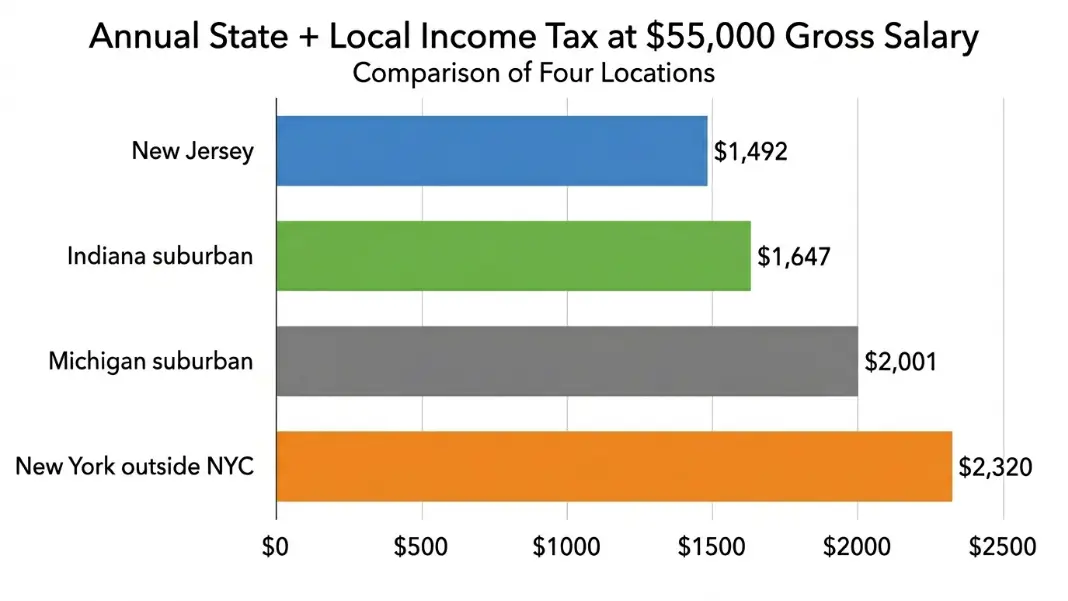
These figures use 2025 rates, single filing status, no pre-tax retirement deductions, and the stated modeled exemptions. Federal income tax and FICA are excluded. Rows labeled "suburban" or "no city/county" reflect the modeled state tax only.
Annual state-level tax at $55,000 gross salary:
| State / Location | State Tax | Local Tax | Total | Effective Rate |
|---|---|---|---|---|
| New Jersey | $1,492 | $0 | $1,492 | 2.71% |
| Indiana (no county) | $1,647 | $0 | $1,647 | 2.99% |
| Michigan (no city) | $2,001 | $0 | $2,001 | 3.64% |
| New York (outside NYC) | $2,320 | $0 | $2,320 | 4.22% |
| Indiana (Marion County) | $1,647 | $1,091 | $2,738 | 4.98% |
| Michigan (Detroit) | $2,001 | $1,320 | $3,321 | 6.04% |
| New York (NYC resident) | $2,320 | $1,698 | $4,018 | 7.31% |
Annual state-level tax at $85,000 gross salary:
| State / Location | State Tax | Local Tax | Total | Effective Rate |
|---|---|---|---|---|
| New Jersey | $3,225 | $0 | $3,225 | 3.79% |
| Indiana (no county) | $2,562 | $0 | $2,562 | 3.01% |
| Michigan (no city) | $3,216 | $0 | $3,216 | 3.78% |
| New York (outside NYC) | $4,074 | $0 | $4,074 | 4.79% |
| Indiana (Marion County) | $2,562 | $1,697 | $4,259 | 5.01% |
| Michigan (Detroit) | $3,216 | $2,040 | $5,256 | 6.18% |
| New York (NYC resident) | $4,074 | $2,860 | $6,934 | 8.16% |
A few things the tables show clearly:
New Jersey's advantage at $55,000 disappears at $85,000. At $55K, NJ workers pay less state tax than Indiana. By $85K, Indiana (outside major counties) is $663 cheaper. The break-even for state tax is roughly $78,000, where New Jersey's effective rate on the full salary crosses Indiana's flat 3.05%.
Indiana is the most predictable state in this group. The effective state rate holds steady at about 3.01% regardless of whether you earn $55,000 or $85,000. Workers planning income growth or variable compensation can predict their Indiana tax burden with more confidence than in any bracket-based state.
Michigan's suburban rate (3.64%-3.78%) is competitive, slightly higher than Indiana's flat rate but lower than New York's at both income levels. Detroit city tax changes that picture significantly: a Detroit resident at $85,000 pays $2,040 more per year than a suburban Michigan worker at the same salary.
The NYC premium is real and consistent. A New York City resident at $85,000 pays $2,860 more per year than a worker in upstate New York at the same salary, and $4,372 more than a New Jersey worker. That gap does not narrow with income, and for workers deciding between living in Manhattan and commuting from New Jersey, it is a number worth calculating annually.
The Michigan Paycheck Calculator applies the correct city rate based on your residence and shows the full breakdown alongside federal taxes.
New York withholds state income tax based on graduated brackets ranging from 4% to 9.65%. For a single filer with no pre-tax deductions, the standard deduction is $8,000. At $55,000 gross salary, state tax is approximately $2,320 per year ($193/month). At $85,000, it is approximately $4,074 ($340/month). NYC residents pay an additional city income tax of roughly 3.1% to 3.9% on top of the state amount.
New Jersey's state income tax uses graduated brackets starting at 1.4% on the first $20,000 of taxable income. For a single filer at $55,000, the effective state tax rate is 2.71%, lower than Indiana's flat 3.05%. The top bracket of 10.75% applies only above $1,000,000. At $85,000, the effective NJ rate rises to 3.79% as income reaches the 6.37% bracket. There is no New Jersey city or county income tax.
Yes. Every Indiana county levies a county income tax in addition to the 3.05% state flat rate. County rates range from approximately 0.5% in some rural counties to 2.02% in Marion County (Indianapolis). The county tax uses the same taxable base as the state tax and is withheld by the employer. An Indianapolis worker at $55,000 pays approximately $1,091 in county tax on top of $1,647 in state tax, for a combined $2,738.
Michigan's state income tax rate is 4.05%, applied to all taxable income after a $5,600 personal exemption for the 2025 tax year. At $55,000, state tax is approximately $2,001 (3.64% effective). Some Michigan cities charge an additional city income tax: Detroit charges 2.4% for residents and 1.2% for non-residents. Suburban Michigan workers pay only the 4.05% state rate. The Michigan Paycheck Calculator applies the correct city rate if you live in a taxing city.
New York City residents pay city income tax using brackets from 3.078% to 3.876%. The NYC standard deduction is $8,000 for a single filer, the same as the state standard deduction. At $55,000 gross salary, the city tax is approximately $1,698 per year. At $85,000, it is approximately $2,860. Workers who commute into NYC from New Jersey, Connecticut, or other areas outside the five boroughs do not pay the city tax, even if they work a full day in Manhattan.
At $55,000, a New Jersey worker pays $1,492 in state tax versus $2,320 for a New York worker outside NYC, a difference of $828 per year. At $85,000, the gap widens: NJ charges $3,225 versus New York's $4,074, a $849 difference. For NYC residents, the gap is much larger: a Manhattan resident at $85,000 pays $6,934 in combined state and city tax, compared to $3,225 for a New Jersey worker at the same salary.
Written by
Hassaan Rasheed
Web Developer & Content Researcher
Hassaan builds calculators and writes source-linked guides across the site's subject areas. Calculator methods and reference data are documented in each guide so readers can verify the underlying sources.
About the author and methods