Square Footage Calculator: How to Measure Any Room or Space (2026)
Square footage is length times width for simple rooms. L-shapes and bay windows change the math. Exact method for rooms, floors, and whole houses.
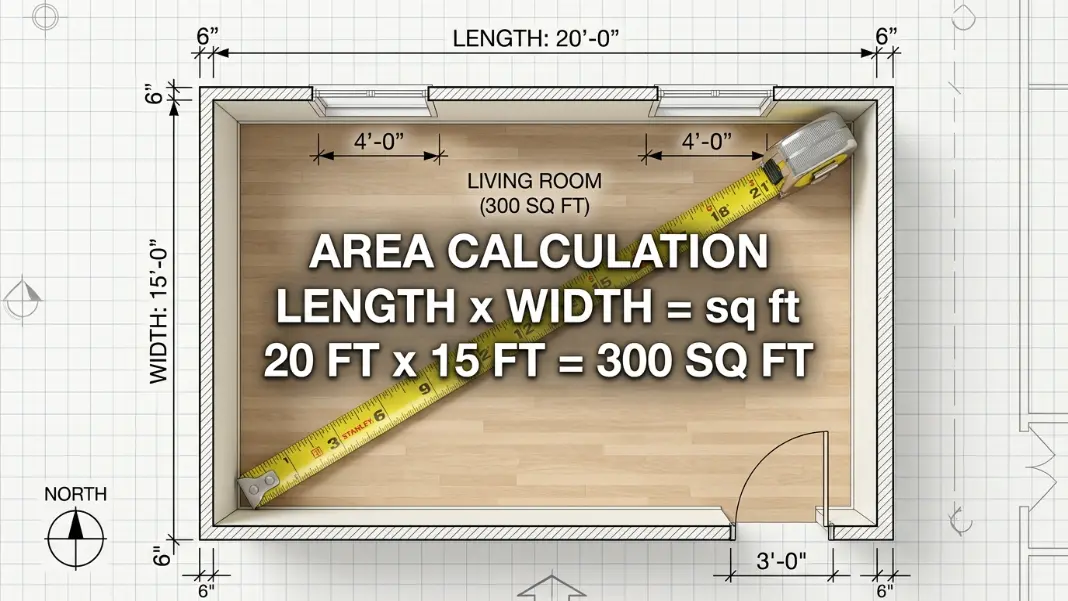
Most measurement errors happen before the tape hits the floor. People measure to the wrong boundary, skip the closet bump-out, or forget to account for a bay window alcove. The formula itself is not the problem: for a simple rectangle, it is length times width. The difficulty is deciding what to measure, where to start, and what counts toward the total.
Use the Square Footage Calculator to enter your dimensions and get the area instantly. This guide explains how to get those dimensions right, including for L-shaped rooms, irregular spaces, and whole-house calculations that match how appraisers measure.
How to Calculate Square Footage of a Room#
For a rectangular room, the formula is:
Square Footage = Length (ft) x Width (ft)
Worked example: A bedroom that measures 14 feet by 12 feet.
14 x 12 = 168 sq ft
Measure from interior wall surface to interior wall surface. Do not include wall thickness. Use the inside dimensions of the room, not the exterior dimensions of the house.
If your measurements are in inches: Convert to feet first by dividing by 12, or divide the inch result by 144.
- 168 inches x 144 inches = 24,192 square inches
- 24,192 / 144 = 168 sq ft
The easiest approach is to work in decimal feet from the start. 14 feet 6 inches becomes 14.5 feet.
Unit conversion reference:
| Square Feet | Square Meters | Square Yards |
|---|---|---|
| 100 | 9.3 | 11.1 |
| 500 | 46.5 | 55.6 |
| 1,000 | 92.9 | 111.1 |
| 1,500 | 139.4 | 166.7 |
| 2,000 | 185.8 | 222.2 |
| 2,500 | 232.3 | 277.8 |
Square meters = square feet x 0.0929
Square feet = square meters x 10.764
A 2,000 sq ft home is 185.8 square meters, the standard unit for property listings outside the United States. Flooring and tile sold in metric quantities also use square meters; the conversion matters any time you are ordering materials from a supplier using metric pricing.
What to include in the room area:
- Closets (most appraisers include standard closets; some exclude large walk-ins)
- Alcoves and bay window bump-outs
- Any space within the walls of the room, even if the shape is awkward
What to exclude:
- Wall thickness
- Structural columns or posts that protrude into the room
- Areas under sloped ceilings in attics where height drops below 5 feet
How to Measure L-Shaped and Irregular Rooms#
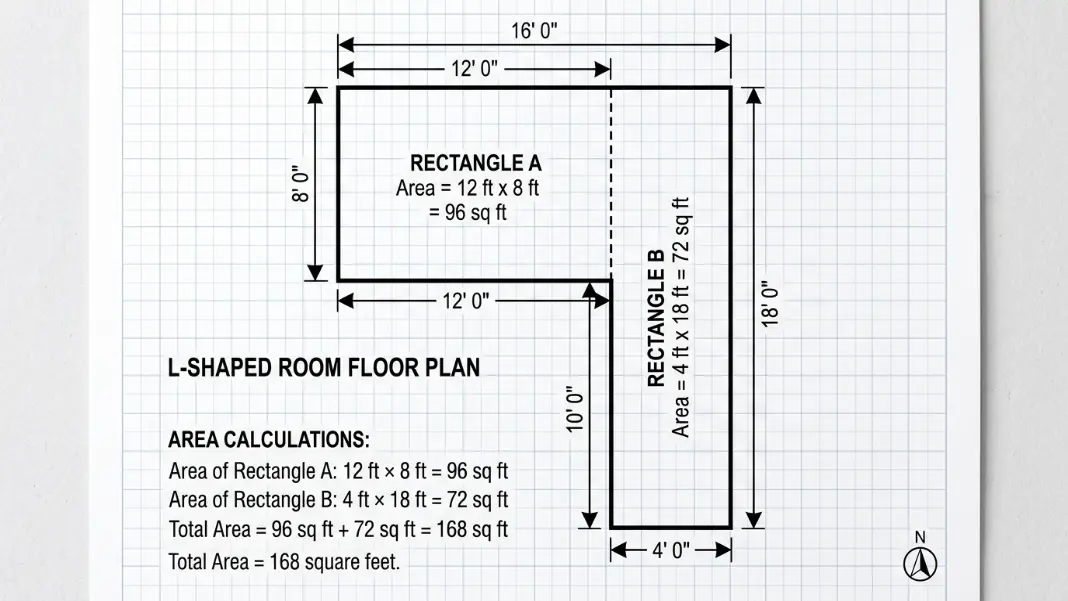
L-shaped rooms, rooms with bump-outs, and open floor plans with angled walls require breaking the space into simple shapes and adding the areas together.
L-shaped room method:
Split the L into two rectangles. Measure each rectangle separately, then add.
- Rectangle A: 20 ft x 14 ft = 280 sq ft
- Rectangle B: 12 ft x 10 ft = 120 sq ft
- Total: 280 + 120 = 400 sq ft
There are two valid ways to draw the dividing line. Either works as long as you do not double-count any area. Sketch the room on paper before measuring if the shape is complex.
Triangular spaces (attic knee walls, angled ceilings, dormers):
Triangle Area = (Base x Height) / 2
A triangular dormer with a 6-foot base and 4-foot height: (6 x 4) / 2 = 12 sq ft
Trapezoid (rooms with one angled wall):
Trapezoid Area = ((Side A + Side B) / 2) x Height
Where Side A and Side B are the two parallel walls, and Height is the perpendicular distance between them.
Circular or curved walls: Measure the radius of the curve and calculate the area of the full circle (pi x r^2), then take the fraction that applies to your space. A quarter-circle bay window with a 4-foot radius: 3.14159 x 4^2 x 0.25 = 12.6 sq ft
For rooms with multiple irregular sections, calculate each section separately and sum all sections for the total.
T-shaped rooms (common in open floor plans where a partition creates a jog, or where a hallway opens into a wider space):
Split the T into two non-overlapping rectangles. Draw the dividing line at the edge where the stem meets the wider bar, so the two rectangles share a boundary but do not overlap.
Example: a T-shaped open space where the top bar is 18 ft x 8 ft and the stem below it is 6 ft x 10 ft.
- Top bar: 18 x 8 = 144 sq ft
- Stem: 6 x 10 = 60 sq ft
- Total: 144 + 60 = 204 sq ft
The error that comes up repeatedly: drawing the dividing line through the intersection zone rather than at its edge, which counts that strip twice. Sketch the shape on paper and mark each rectangle with a different pen before you start measuring.
How Real Estate Agents and Appraisers Measure Square Footage#
Real estate listings use Gross Living Area (GLA), which is not the same as the total floor area of the building. Appraisers follow ANSI Z765 standards in most US markets.
ANSI GLA rules:
- Above-grade finished space only (basement does not count, even if fully finished)
- Space must be heated and cooled by a permanently installed system
- Ceiling height must be at least 7 feet for the majority of the space (5 feet minimum under sloped ceilings)
- Measured from exterior walls, not interior surfaces
Finished basements, detached garages, and unheated sunrooms do not count toward GLA. They add value to a property but are listed separately in appraisals.
Exterior vs interior measurement:
Appraisers measure from the exterior walls outward. Homeowners and contractors typically measure interior walls. Exterior measurement is larger by the thickness of all exterior walls, usually 4 to 8 inches per side. For a 1,500 sq ft home, this difference can be 50 to 100 sq ft.
When comparing your own room-by-room measurements to a listing or appraisal, expect the listing number to be slightly higher. This is not a discrepancy; it is a different measurement convention.
Square Footage for Flooring: How Much Material to Order#
Flooring is priced and sold per square foot. If you order exactly the measured area, you will run short. Every installation requires extra material for cuts, waste, and pattern matching.
Standard waste factors by material:
| Flooring Type | Add This Much | Notes |
|---|---|---|
| Hardwood (straight lay) | 8-10% | Allows for cuts and defective boards |
| Tile (straight lay) | 10% | Add 15% for large-format tile |
| Tile (diagonal lay) | 15% | More cuts at all edges |
| Laminate | 10% | Add 15% in rooms with many angles |
| Carpet | 10-15% | Plus extra for patterned seam matching |
| LVP / LVT | 10% | Similar to laminate |
How to order:
- Calculate the room area in square feet.
- Multiply by (1 + waste factor). For 168 sq ft at 10%: 168 x 1.10 = 184.8 sq ft, round up to 185.
- Purchase the next full box or roll quantity above that number.
Always buy from the same production lot. Small packages from different lots can have noticeable color variation after installation, even within the same product line.
Estimating Paint and Tile from Your Room's Square Footage#
Floor area tells you how much flooring you need. Paint and wall tile require a separate wall area calculation; using the floor square footage for these will produce the wrong quantity.
Wall area formula:
Wall Area = (2 x Length + 2 x Width) x Ceiling Height
Subtract roughly 20 sq ft per door and 15 sq ft per standard window after calculating the full perimeter.
For the 14 x 12 room with 8-foot ceilings:
- Total wall area: (2 x 14 + 2 x 12) x 8 = 52 x 8 = 416 sq ft
- Minus one door and two windows: 416 - 20 - 30 = 366 sq ft of paintable wall
One gallon of standard interior paint covers 350 to 400 sq ft on smooth drywall. That room takes about 1 gallon per coat. Add the room's floor area (168 sq ft) separately if you are also painting the ceiling; it is a different surface with its own square footage.
Material cost reference by surface type:
| Material | Typical Material Cost | Waste to Add |
|---|---|---|
| Interior paint | $0.25 to $0.65 per sq ft of wall | None (no waste factor) |
| Ceramic floor tile | $1.50 to $4.00 per sq ft | 10% |
| Porcelain tile | $3.00 to $7.00 per sq ft | 10 to 15% |
| Hardwood flooring | $5.00 to $10.00 per sq ft | 8 to 10% |
| LVP / LVT plank | $2.00 to $5.00 per sq ft | 10% |
These are material costs only. Installation labor typically adds $2 to $8 per sq ft depending on material and region. Multiply the area by the combined material and labor rate to estimate total project cost.
Wall tile in a shower or backsplash:
Wall tile quantity is based on the tiled wall surface, not the floor area. For a shower with three tiled walls each 4 ft wide and 8 ft tall:
Shower tile area = 3 x (4 x 8) = 96 sq ft
Add 10% waste = 96 x 1.10 = 105.6 sq ft to order
The floor area of that shower is roughly 12 to 16 sq ft. That number has no relationship to the wall tile quantity. Measure each tiled wall independently and calculate wall area and floor area as separate line items for any tile project.
For rental units where you are measuring rooms to justify a rent adjustment after renovation, the How to Calculate Prorated Rent guide covers how square footage and move-in timing interact when pricing partial-month rent.
Total House Square Footage vs Livable Area#
A common source of confusion is why a listing says one number but the house has more usable space.
Total floor area includes every enclosed space: garage, unfinished basement, storage areas, attached storage rooms. This is the largest possible number.
Gross Living Area (GLA) is what appraisers and most MLS listings report: finished, heated, above-grade space only.
Heated and cooled area is what HVAC contractors use to size systems. Usually close to GLA but may include a heated garage or sunroom that does not qualify as GLA.
Example breakdown for a typical house:
| Area | Sq Ft | Counts as GLA? |
|---|---|---|
| Main floor | 1,100 | Yes |
| Second floor | 900 | Yes |
| Finished basement | 700 | No |
| Attached garage | 400 | No |
| Unfinished attic storage | 500 | No |
| GLA Total | 2,000 | |
| Total enclosed space | 3,600 |
The home lists at 2,000 sq ft in real estate records, but the owner has 3,600 sq ft of enclosed space. Both numbers are accurate; they measure different things.
When buying a home, confirm which measurement was used and whether the basement is included. If the square footage matters for your decision, ask the seller for the appraisal or hire your own appraiser before closing.
For investment properties where you are evaluating value per square foot alongside rental income, the How to Calculate Cap Rate guide combines net operating income with purchase price to give you a return metric that complements the square footage analysis.
Square footage equals length in feet multiplied by width in feet. For a 14-foot by 12-foot room: 14 x 12 = 168 square feet. For L-shaped rooms, split into rectangles, calculate each, and add the totals. If your measurements are in inches, multiply length by width and divide by 144 to convert to square feet.
Divide the L shape into two rectangles. Measure the length and width of each rectangle separately. Calculate the area of each (length x width) and add the two results together. There are two ways to draw the dividing line, and both give the same total as long as you do not overlap or leave a gap between the two rectangles. Sketch the room on paper before measuring to avoid errors.
Not in real estate GLA calculations under ANSI Z765 standards. Below-grade space, even if fully finished with bedrooms and bathrooms, is listed separately from GLA. Appraisers assign value to a finished basement and note it in the report, but it does not appear in the main square footage figure. A listing showing 2,000 sq ft GLA may have 2,700 total finished square feet once the basement is counted.
Add 10% for standard hardwood, laminate, and LVP. Add 15% for diagonal tile layouts or rooms with many angles. Add 10-15% for carpet, plus additional for patterned carpet that requires matched seams. Always order from the same production lot. Running short and ordering a second shipment frequently results in a visible color difference between the batches.
Interior measurement runs from wall surface to wall surface inside the room. Exterior measurement runs from the outside face of one wall to the outside face of the opposite wall. Appraisers use exterior measurement per ANSI standards. The interior measurement is smaller by the thickness of both exterior walls, typically 8 to 16 inches per direction. For a 1,500 sq ft home, the difference between interior and exterior measurements is usually 50 to 150 sq ft.
Measure both dimensions in inches, multiply them together, then divide by 144 (since 1 square foot = 144 square inches). Example: a room measuring 168 inches by 144 inches is 168 x 144 = 24,192 square inches, divided by 144 = 168 square feet. Alternatively, convert each measurement to decimal feet before multiplying: 168 inches divided by 12 = 14 feet, 144 inches divided by 12 = 12 feet, 14 x 12 = 168 sq ft.
Written by
Hassaan Rasheed
Web Developer & Content Researcher
Hassaan builds calculators and writes source-linked guides across the site's subject areas. Calculator methods and reference data are documented in each guide so readers can verify the underlying sources.
About the author and methods