A1C Calculator: Blood Glucose Conversion, Formula, and Chart (2026)
Convert average blood glucose to an ADAG-estimated A1C, or A1C to eAG. Worked examples, mg/dL and mmol/L tables, and why GMI and lab A1C differ.
An average glucose of 154 mg/dL gives an ADAG-estimated A1C of about 7.0%. That is a calculation from glucose data, not a laboratory measurement or a diabetes diagnosis. The A1C Calculator supports average glucose to estimated A1C and the reverse A1C-to-eAG conversion, in mg/dL and mmol/L.
The estimate uses a population relationship. Your laboratory A1C can differ because of the period sampled, glucose-data coverage, red-cell biology, or the laboratory method. There is no fixed error margin that makes the estimate interchangeable with your lab result.
The ADAG Formula and Worked Examples#
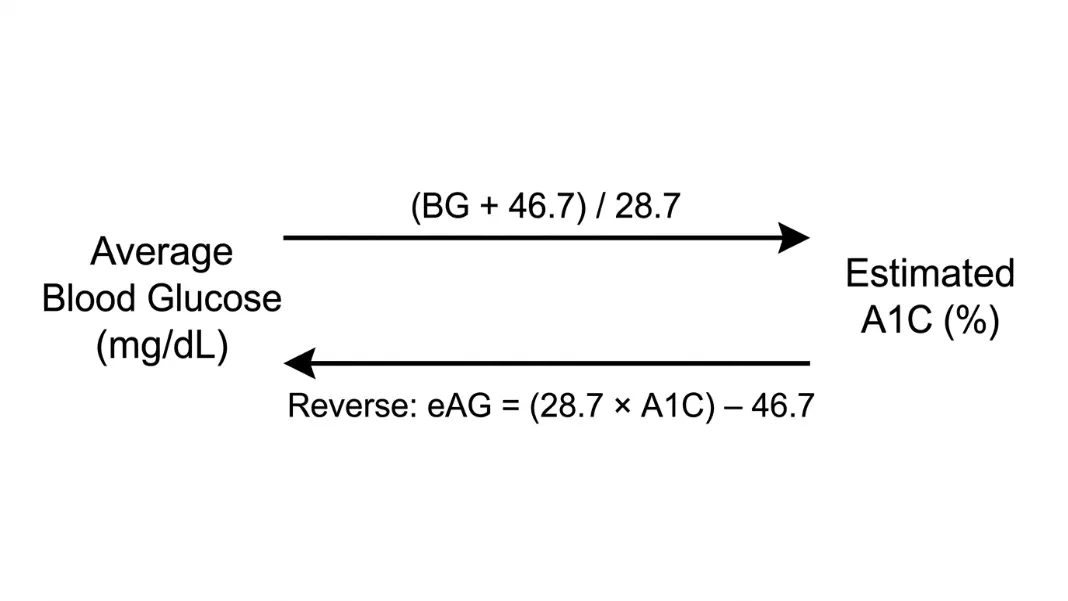
The original ADAG study, Nathan and colleagues (2008) related laboratory A1C to average glucose measured over three months in 507 participants, using CGM and frequent fingerstick measurements. Its equation expresses A1C as estimated average glucose, or eAG. Rearranging that equation gives this calculator's estimate:
Estimated A1C (%) = (Average Glucose mg/dL + 46.7) / 28.7
eAG (mg/dL) = (28.7 × A1C) - 46.7
For an average glucose of 126 mg/dL:
Estimated A1C = (126 + 46.7) / 28.7
              = 6.02%
              ≈ 6.0%
For a measured A1C of 7.5%:
eAG = (28.7 × 7.5) - 46.7
    = 168.55 mg/dL
    ≈ 169 mg/dL
The second answer estimates the glucose average associated with that A1C in the study relationship; it does not reconstruct your individual glucose readings.
Using mg/dL or mmol/L#
The calculator converts glucose from mmol/L to mg/dL using a factor of 18.018, then applies the same ADAG equation. It divides by 18.018 for the reverse unit conversion.
Estimated A1C (%) = (Average Glucose mmol/L × 18.018 + 46.7) / 28.7
eAG (mmol/L) = ((28.7 × A1C) - 46.7) / 18.018
For 10.1 mmol/L, the calculation gives 7.97%, or about 8.0%. Keep unrounded values through the calculation; different rounding of conversion constants can slightly change the last displayed digit.
Choose a representative input. A single fasting reading cannot stand in for an overall average. Fasting-only logs can also miss post-meal and overnight glucose. Check which dates and times your meter or CGM average includes, and whether there are substantial gaps. A recent short period may not represent the same interval as a laboratory A1C.
GMI and Laboratory A1C Are Different Measurements#
Glucose Management Indicator uses a separate equation developed from CGM data. The original GMI paper, Bergenstal and colleagues (2018) introduced the name to help distinguish the estimate from a laboratory A1C result:
GMI (%) = 3.31 + 0.02392 × Mean CGM Glucose (mg/dL)
GMI comes from glucose readings; a laboratory A1C assay measures glycated hemoglobin in blood. A mathematical conversion between formulas cannot determine your actual laboratory A1C. The current calculator provides ADAG/eAG conversions; the GMI equation here is an explanatory comparison.
For example, at 183 mg/dL, ADAG gives 8.00% and GMI gives 7.69%. This difference follows from the equations and does not establish which result matches an individual's lab measurement. The mean-glucose comparison guide shows more examples.
A1C and eAG Reference Table#
The glucose columns below are calculated from each listed A1C using ADAG. They are estimated averages, not fasting-glucose diagnostic thresholds.
| A1C (%) | eAG (mg/dL) | eAG (mmol/L) |
|---|---|---|
| 5.0 | 97 | 5.4 |
| 5.7 | 117 | 6.5 |
| 6.0 | 126 | 7.0 |
| 6.5 | 140 | 7.8 |
| 7.0 | 154 | 8.6 |
| 7.5 | 169 | 9.4 |
| 8.0 | 183 | 10.2 |
| 9.0 | 212 | 11.8 |
| 10.0 | 240 | 13.3 |
For an appropriate laboratory A1C test, NIDDK describes values below 5.7% as normal, 5.7–6.4% as prediabetes, and 6.5% or above as meeting the diabetes threshold. Confirmation is generally needed when there are no clear symptoms. Those categories must not be used to diagnose diabetes from a glucose-derived estimate.
Diagnosis and treatment targets also differ. The ADA's 2026 glycemic-goal guidance gives an A1C goal below 7% for many nonpregnant adults with diabetes, with individual targets adjusted for circumstances such as hypoglycemia risk.
Why the Estimate and Lab Result Can Disagree#
Red cells and the assay. The NGSP interference guidance explains that hemolytic anemia or recovery from blood loss can lower A1C through shortened red-cell survival. Iron deficiency anemia is associated with higher A1C. Effects of hemoglobin variants depend on the assay. Recent transfusion or kidney disease can further complicate interpretation; do not assume one direction of error for every condition.
Timing and glucose coverage. Laboratory A1C reflects roughly three months, with recent glucose having more influence. A CGM average over another period, or meter checks concentrated at one time of day, may describe a different glucose pattern. Sensor or measurement problems can also affect the input.
Individual variation. Population equations cannot account for every person's relationship between glucose and hemoglobin glycation. Agreement between two numbers does not prove that either measurement is free of error.
Discuss a persistent or unexpected mismatch with your clinician, bringing the lab date, glucose-report period, and available glucose readings. They can decide whether to check the assay, data coverage, or other conditions. Medication changes should not be based on this calculator alone.
Add 46.7 to a representative average glucose in mg/dL, then divide by 28.7. At 154 mg/dL, the estimate is 6.99%, which rounds to 7.0%. The A1C Calculator also accepts mmol/L. The answer is an estimate, not a measured A1C.
No formula determines your individual laboratory A1C from GMI. GMI is calculated from CGM glucose data with a different equation from ADAG. A blood test measures A1C directly.
A single reading does not represent overall glucose exposure. Averaging fasting-only readings can still omit post-meal and overnight glucose. Review the coverage and dates of your glucose report before using its average.
Estimated average glucose expresses an A1C value in glucose units. At A1C 7.0%, the ADAG equation gives 154.2 mg/dL, displayed as about 154 mg/dL or 8.6 mmol/L. It is not a fasting-glucose value.
No. The diagnostic threshold applies to appropriate laboratory testing and clinical interpretation. A glucose-derived estimate is not a diagnostic test; discuss testing with a health professional.
Yes. Iron deficiency anemia can raise A1C independently of glucose, whereas hemolytic anemia can lower it. The cause matters; ask your clinician to interpret a mismatch instead of adjusting the estimate yourself.
References
Written by
Hassaan Rasheed
Web Developer & Content Researcher
Hassaan builds calculators and writes source-linked guides across the site's subject areas. Calculator methods and reference data are documented in each guide so readers can verify the underlying sources.
About the author and methods